
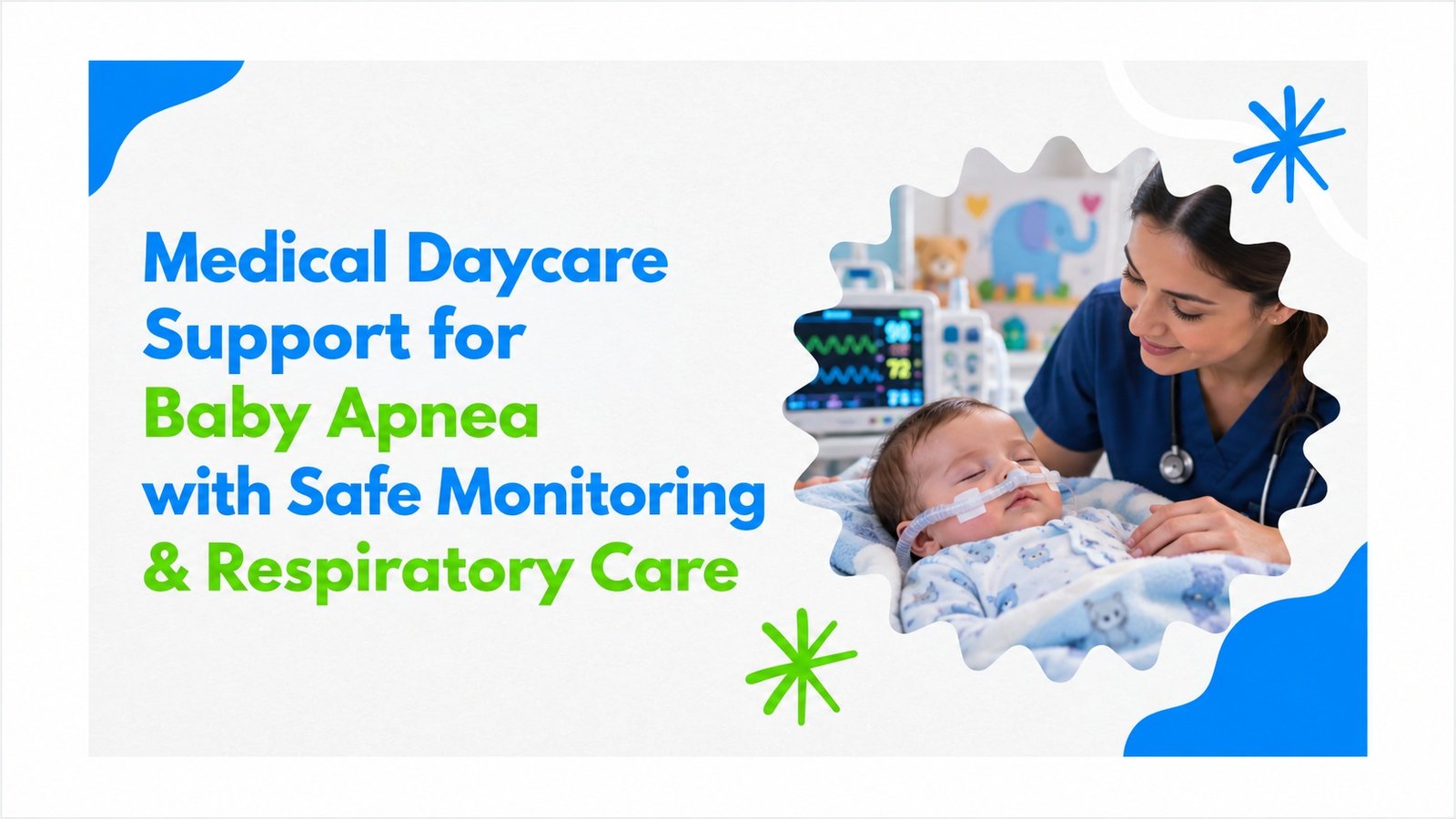
The moment a monitor alarm sounds in the medical emergency of the night, everything changes. For parents of infants and young children with apnea, that alarm and the terrifying seconds before their baby takes the next breath become a defining feature of daily life. Learn to sleep lightly. You learn to watch your child’s chest rise and fall. You learn that leaving the house, returning to work, or trusting anyone else with your baby’s care feels nearly impossible when every breath matters this much.
But here is what many families in this situation don’t yet know: there is a care setting specifically built for children like yours. One where trained clinical professionals provide continuous respiratory care, monitor your child’s breathing, respond immediately when patterns change, and deliver this level of oversight not just while they’re sleeping, but throughout the entire time they’re in the care of qualified nurses and medical staff. Medical daycare for infants and children with respiratory conditions is not a compromise on your child’s safety. For many families, it is the safest place their child can be outside of the hospital.
Here is everything you need to understand about what baby apnea is, what safe monitoring looks like, and how the right medical daycare program can support your child and give your family its life back.
What Is Baby Apnea?
Apnea is defined as a pause in breathing lasting 20 seconds or longer, or a shorter pause accompanied by a drop in heart rate (bradycardia) or oxygen saturation. In infants and young children, apnea can be classified into three primary types. Because apnea can lead to serious breathing complications, children with persistent or severe episodes often require close monitoring and skilled nursing support to ensure timely intervention and ongoing respiratory care.
- Central apnea, where the brain temporarily fails to send the correct signals to the muscles that control breathing
- Obstructive apnea occurs when a physical blockage in the airway, such as relaxed throat muscles or enlarged tonsils, interrupts normal airflow.
- Mixed apnea, which combines elements of both central and obstructive patterns
Apnea of prematurity is particularly common in infants born before 37 weeks of gestation, as their neurological and respiratory systems are not yet fully developed. Many premature infants experience apnea episodes in the NICU and may continue to require monitoring after discharge.
Beyond prematurity, infant apnea can be associated with respiratory infections such as RSV, gastroesophageal reflux, neurological conditions, anemia, metabolic disorders, or cardiac conditions that may require ongoing monitoring or supportive medical devices. In some cases, no underlying cause is identified, a presentation previously referred to as apparent life-threatening events (ALTE) and now more often classified as Brief Resolved Unexplained Events (BRUE).
Why Standard Childcare Cannot Safely Support a Child With Apnea
For parents considering their childcare options, the instinct is often to look for a “careful” or “attentive” caregiver, someone who will watch your child closely. But the challenge with apnea is not attentiveness. It is clinical competence.
Safe monitoring and response for a child with apnea requires:
- Continuous cardiorespiratory monitoring equipment that measures heart rate, respiratory rate, and oxygen saturation in real time
- Knowledge of your child’s individual alarm parameters, the specific thresholds set by their physician that determine when a clinical response is needed.
- The clinical skill to distinguish a true apnea event from a monitor artifact, positional change, or movement-related alarm
- Immediate response capability, including stimulation protocols, supplemental oxygen administration, and, when necessary, bag-mask ventilation
- Clear escalation protocols specifying when to call the physician and when to activate emergency services
Standard childcare for special needs settings, even well-intentioned ones, is not equipped with this combination of technology, training, and protocol infrastructure. A caregiver who notices a baby has stopped breathing is not the same as a licensed nurse who recognizes the early respiratory pattern change that precedes a significant apnea event and responds before the monitor alarms.
This clinical distinction is the difference between reactive care and genuinely safe care for a child with apnea.
What Safe Apnea Monitoring Looks Like in Medical Daycare
In a quality medical daycare program, respiratory monitoring is not an add-on service; it is an integrated clinical competency that the entire program is built around. Here is what safe, professional respiratory monitoring looks like in practice:
Continuous Cardiorespiratory Monitoring
Children with chronic respiratory conditions in a PPEC medical daycare setting are monitored using hospital-grade cardiorespiratory monitors throughout the program day. These monitors continuously track heart rate, respiratory rate, and oxygen saturation, with individualized alarm thresholds set according to each child’s physician-prescribed parameters. Nurses do not simply respond to alarms; they actively observe monitoring data alongside the child, identifying patterns and trends that may indicate potential concerns before an event occurs, allowing for timely intervention and continuous, high-quality care.
Individualized Response Protocols
Every child with chronic respiratory conditions in a medical daycare program has an individualized response protocol developed in coordination with their treating physician or neonatologist. This protocol specifies:
- The exact alarm thresholds that trigger a clinical response
- The sequence of interventions, from tactile stimulation to supplemental oxygen to emergency escalation
- When to administer rescue medications if prescribed
- Notification thresholds for family and physician contact
- Criteria for activating emergency medical services
These protocols are not generic; they are tailored to each child’s specific respiratory patterns, underlying diagnosis, and the physician’s directives.
Positioning and Environmental Management
For infants with respiratory disorders, safe positioning is a continuous clinical consideration. Nurses in a medical daycare maintain safe sleep and positioning practices throughout the day, understanding how positional changes, feeding, activity, and sleep transitions affect apnea risk for individual children. They also collaborate with a pediatric physical therapist to support proper positioning, improve movement patterns, and promote respiratory function based on each child’s individual needs.
For infants with reflux-associated respiratory conditions, feeding protocols are managed by nursing staff in coordination with speech and feeding therapists and a pediatric physical therapist to support safe positioning during and after feeding, helping minimize aspiration and reflux-triggered respiratory events while encouraging healthy physical development.
Oxygen Administration Capability
When respiratory events require supplemental oxygen, either as a prescribed standing order or as an emergency response, medical daycare nursing staff are equipped and trained to administer it. Immediate oxygen supply, delivery equipment, and backup systems are maintained on-site, eliminating the equipment gaps that can make home management of apnea events acutely dangerous.
The Integrated Care Advantage for Infants With Respiratory Disorders
Beyond the clinical monitoring itself, medical daycare offers children with respiratory conditions something that hospital follow-up and home monitoring alone cannot: the opportunity to develop normally during a period when their medical needs might otherwise consume every available resource and attention.
Infants and young children with respiratory conditions , particularly those born prematurely, frequently have associated developmental needs. They may have feeding difficulties, motor delays, or sensory processing differences that benefit from early therapeutic intervention. In a medical daycare setting, physical therapy, occupational therapy, and speech and feeding therapy are integrated into daily programming alongside clinical monitoring.
This means that while a nurse is monitoring your child’s cardiorespiratory status, a speech and feeding therapist is supporting oral feeding development. While positioning protocols protect against risk, a physical therapist is building the motor foundations that support your child’s long-term development. Medical stability and developmental progress happen simultaneously, not sequentially.
What This Means for Your Family
For parents whose lives have contracted around their child’s pulse oximeter, medical daycare offers something profound: the ability to trust, for the first time, that your child is genuinely safe in someone else’s care.
This trust has practical consequences. It means returning to work is possible because care hours align with typical work schedules and skilled nurses manage respiratory events on-site. It means sleeping more than an hour at a time is possible because the hypervigilance that apnea monitoring demands at home is shared with a clinical team during program hours. It means the sibling who has been living on the margins of family attention gets their parent back, even partially, during the day.
The right medical daycare does not replace your love, your vigilance, or your role as your child’s parent. It adds the clinical infrastructure that makes sustainable family life possible alongside a medical reality that would otherwise be overwhelming.
What to Look for in a Medical Daycare for a Child With a Respiratory Condition
If you are evaluating medical daycare options for a child with a respiratory condition, ask specific clinical questions:
- Do you use continuous cardiorespiratory monitors for all children with serious respiratory diagnoses?
- How are alarm thresholds set, and who reviews and updates them?
- Can you walk me through your response protocol for a respiratory event?
- Are your nursing staff trained in infant CPR, bag-mask ventilation, and oxygen administration?
- Do you have individualized emergency protocols for each enrolled child?
- How do you coordinate with our child’s neonatologist or pulmonologist?
- What is your communication process with families when a respiratory event occurs?
A program with genuine clinical competence in respiratory management will answer these questions in detail, without hesitation. Specific, confident answers, not general reassurances, are the indicators of a program you can trust with your child’s care.
Conclusion
A chronic respiratory diagnosis is one of the most anxiety-producing medical realities a family can navigate. The relentless monitoring, constant vigilance, and the near impossibility of entrusting your child to someone else’s care can make daily life feel overwhelming. Specialized care pediatrics PPEC programs help change that reality, not by minimizing the seriousness of your child’s condition, but by providing the clinical expertise and supportive environment needed to manage complex respiratory conditions safely throughout the day.
At PPEC of Palm Beach, we provide continuous cardiorespiratory monitoring, individualized respiratory care plans, and integrated nursing and therapy services that infants and children with respiratory conditions need to stay safe, continue developing, and thrive. Through our specialized care pediatrics PPEC approach, families can feel confident knowing their child is receiving comprehensive medical and developmental support in a nurturing environment. If your child has been diagnosed with a respiratory condition and you’re exploring childcare options, reach out to our team to learn how our program can support your child while giving your family the peace of mind and breathing room you deserve.
FAQs
Can a baby with a respiratory condition safely attend medical daycare?
Yes, in fact, a quality medical daycare is one of the safest environments for a baby with respiratory conditions outside the hospital. Licensed nursing staff provide continuous cardiorespiratory monitoring throughout the program day using hospital-grade equipment, with individualized alarm thresholds and response protocols tailored to each child’s physician-prescribed parameters. This level of clinical oversight is not available in any standard childcare setting.
What equipment is used to monitor respiratory conditions in medical daycare?
Medical daycare programs use continuous cardiorespiratory monitors that track heart rate, respiratory rate, and oxygen saturation in real time throughout the program day. Alarm thresholds are set individually based on each child’s physician directives. Oxygen delivery equipment, emergency supplies, and backup systems are maintained on-site, and nursing staff are trained in immediate response protocol, including stimulation, supplemental oxygen administration, and emergency escalation.
What is the difference between home monitoring and medical daycare monitoring for respiratory conditions?
Pulse oximeters alert caregivers when an event occurs, but the response depends entirely on the caregiver’s training and the equipment available at home. In medical daycare, continuous monitoring is paired with licensed nurses who recognize pre-event respiratory patterns, have individualized response protocols in place, and are equipped to administer oxygen and escalate care immediately. The clinical infrastructure of medical daycare provides a level of safety and response capability that home monitoring alone cannot replicate.
Does my child need a referral to enroll in medical daycare for their respiratory condition?
Yes. Enrollment in a PPEC medical daycare program requires a physician’s prescription certifying that medical daycare is medically necessary for your child. For children with respiratory conditions, this prescription is typically provided by the neonatologist, pulmonologist, or pediatrician managing the child’s respiratory care. The PPEC of Palm Beach enrollment team can assist families with gathering the necessary documentation and navigating the Medicaid authorization process.
Is medical daycare for respiratory conditions covered by Medicaid?
Yes. PPEC services, including care for children with apnea and other complex respiratory needs, are covered by Medicaid for eligible children when certified by a physician as medically necessary. Coverage includes daily nursing care, monitoring, therapies, and medical supplies used during the program day. Families should verify their child’s specific coverage with the PPEC of Palm Beach enrollment team, who can assist with the prior authorization and documentation process.