
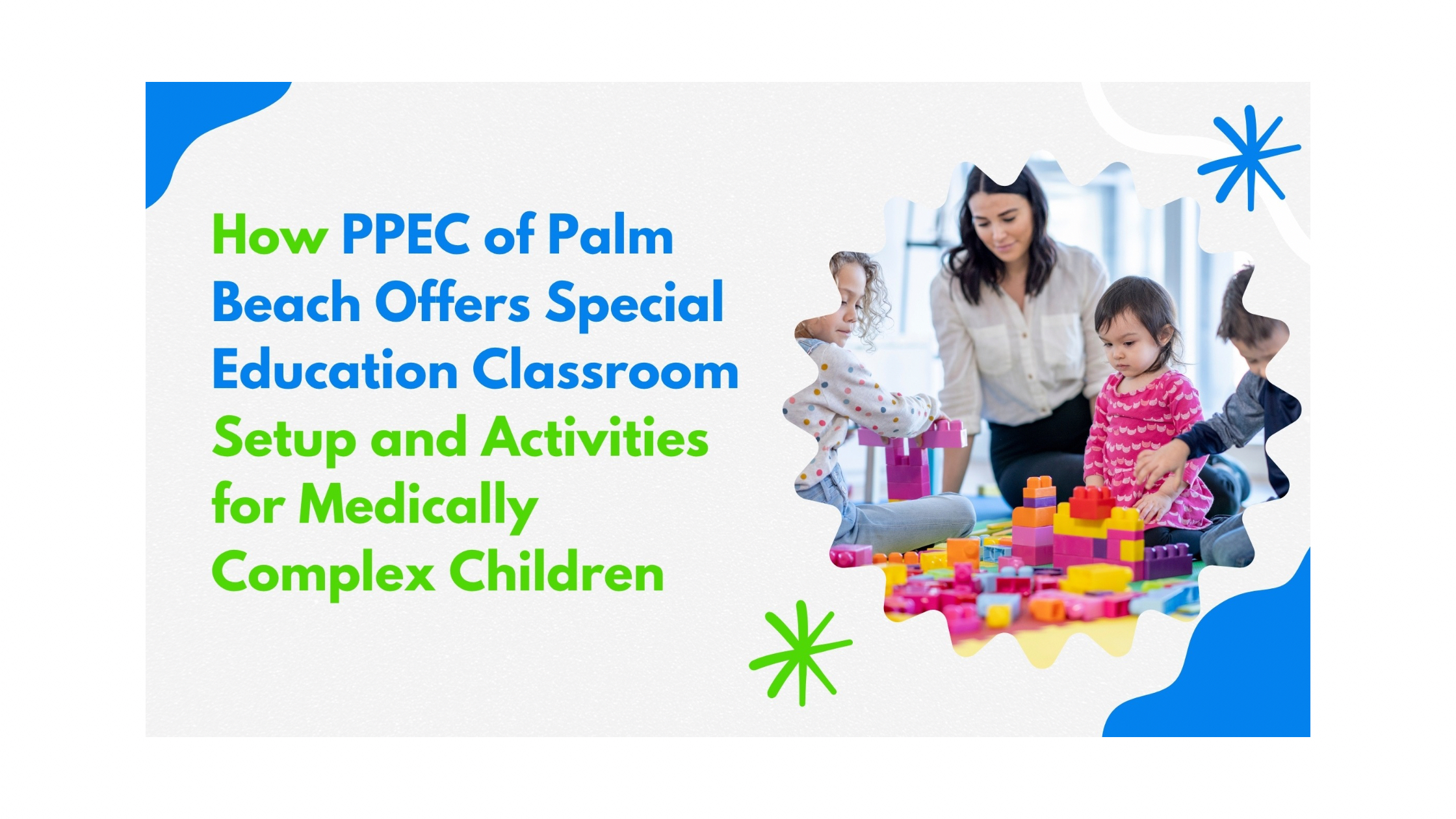
There’s a question that quietly haunts many parents of medically complex children: Can my child actually learn? Not just survive the day, not just get through medical routines, but genuinely learn, grow, and experience the joy of childhood discovery. For families navigating ventilators, feeding tubes, seizure disorders, and developmental delays simultaneously, the idea of structured education can feel like a luxury they can’t afford to prioritize.
At PPEC of Palm Beach, the answer is an unequivocal yes, and the approach proves it every day. Special education for medically complex children isn’t a separate program bolted onto medical care. At PPEC of Palm Beach, it’s woven into every hour of the child’s day, creating a structured learning environment for special needs that makes developmental progress possible without ever compromising medical safety. Here’s how this integrated approach transforms outcomes for children and families alike.
What Makes a Special Education Classroom “Different” for Medically Complex Children?
A traditional classroom is designed for children who arrive healthy, focused, and medically stable. For children managing complex conditions, that environment simply doesn’t work, not because the children can’t learn, but because the setting isn’t built to support them.
A special education classroom for medically complex children looks fundamentally different. It combines:
- Licensed nursing staff present throughout all learning activities, not just on-call
- Adaptive materials and tools that accommodate physical, sensory, or communication limitations
- Flexible scheduling that accounts for medical routines, therapy sessions, and energy levels
- Small group settings that allow individualized attention while still building social skills
- Coordinated goals, where educational objectives and therapeutic goals reinforce each other
PPEC of Palm Beach’s special education classroom model is built on exactly this foundation, creating a space where medical complexity is the starting point, not an obstacle.
5 Ways PPEC of Palm Beach’s Classroom Setup Supports Medically Complex Children
1. A Structured Learning Environment That Accommodates Medical Needs
Children with complex conditions thrive with predictability, and PPEC’s structured learning environment for special needs reflects this understanding. Daily schedules balance academic activities, sensory play, therapy integration, and medical routines in a sequence that children can anticipate and feel secure within.
This structure isn’t rigid; it’s responsive. When a child needs a medical intervention, the day adapts around it rather than stopping entirely. Nurses and educators work side by side, so a brief medical need doesn’t derail a child’s learning momentum or create anxiety.
The result is a classroom atmosphere that feels calm, purposeful, and safe, the exact conditions children need to absorb new information and develop new skills.
2. Curriculum Designed Around Each Child’s Developmental Level
No two medically complex children have identical developmental profiles. One child may have a strong cognitive ability but significant physical limitations. Another may have motor skills intact but require intensive communication support. PPEC of Palm Beach’s special education for medically complex children responds to this reality with individualized programming that meets each child where they are.
Activities are chosen not just for age-appropriateness but for therapeutic and educational value, including:
- Sensory exploration activities that build cognitive awareness and fine motor skills
- Music and movement sessions adapted for children with mobility limitations
- Literacy and numeracy foundations introduced through play-based methods
- Art and creative expression activities that develop fine motor control and self-expression
- Social-emotional learning activities that build communication, turn-taking, and emotional recognition
Every activity serves multiple developmental goals simultaneously, maximizing the value of each hour your child spends in the program.
3. Integrated Therapy That Reinforces Classroom Learning
One of the most powerful features of PPEC, Palm Beach’s special needs daycare, is that therapy doesn’t happen in isolation. Physical, occupational, and speech therapy are woven directly into classroom activities, so the skills children practice with therapists are immediately reinforced in educational settings.
Consider what this looks like in practice:
- A speech therapy goal around requesting objects gets practiced during snack time and play activities, not just during a separate therapy session
- An occupational therapy goal around fine motor control is reinforced through art projects and daily classroom activities
- A physical therapy goal related to positioning or movement is supported throughout the child’s day, not just during a scheduled session.
This integration accelerates progress because children practice skills in meaningful, real-world contexts rather than solely in clinical settings. It also eliminates the exhausting appointment marathon that families previously had to manage independently; all of this happens within the PPEC program at one coordinated location.
4. Communication Development at the Center of Everything
For many medically complex children, communication is both a primary challenge and the gateway to everything else: learning, friendship, self-advocacy, and quality of life. PPEC of Palm Beach’s special education classroom prioritizes communication development across every activity and interaction.
This includes:
- Verbal language development through structured conversation, storytelling, and responsive interaction with educators
- Augmentative and Alternative Communication (AAC) support, including communication devices and picture-based systems, is integrated naturally into classroom routines.
- Sign language support for children who benefit from visual communication strategies.
- Social communication skills such as turn-taking, requesting, and expressing needs are practiced throughout the day in real contexts.
By treating communication as foundational rather than supplementary, PPEC’s approach ensures that children develop the tools they need to engage meaningfully with the world around them.
5. Milestone Recognition That Honors Each Child’s Unique Progress
In a typical educational setting, progress is measured against standardized benchmarks that may be irrelevant to a medically complex child’s journey. At PPEC of Palm Beach, success is defined by each child’s individual trajectory, and every milestone, however small it may appear to an outside observer, is recognized and celebrated.
This matters more than it might seem. When children experience acknowledgment for their efforts and achievements, it builds motivation, self-confidence, and engagement. When families see their child’s progress documented and celebrated by professionals who understand what that progress represents, it provides reassurance and hope that sustains them through difficult periods.
PPEC’s educators and care team understand that a child learning to communicate a simple request, tolerate a sensory experience, or hold a crayon independently represents extraordinary achievement, and they treat it as such.
Why Special Needs Daycare in Palm Beach Should Include Educational Programming
Families sometimes assume that medically complex children need medical management first and education later, once the child is stable enough, old enough, or healthy enough. This assumption, while understandable, actually works against children’s development.
The early years represent a critical window for brain development that cannot be recaptured. Children who receive both medical stability and developmental stimulation during this period have significantly better long-term outcomes than those who receive medical care alone. Special needs daycare in Palm Beach that integrates educational programming isn’t a bonus; it’s a clinical necessity.
PPEC of Palm Beach’s approach recognizes this. By providing a PPEC special education classroom alongside expert nursing care and integrated therapies, the program ensures that children receive everything they need during the hours they’re in the facili ty, not just medical management, but the developmental experiences that shape their cognitive, social, and emotional futures.
What Families Can Expect When Enrolling at PPEC of Palm Beach
Transitioning into PPEC of Palm Beach’s program is a collaborative process. The team takes time to understand your child’s medical history, developmental profile, communication style, and individual goals before programming begins. This means that from day one, activities and interactions are tailored to your child, not to a generic program template.
Families receive:
- Comprehensive daily reports covering medical status, activities, therapy participation, and developmental observations
- Regular communication with the care team about progress, concerns, and goal updates
- Involvement in care planning and educational goal-setting so that home and facility environments reinforce each other
- Connection with other families navigating similar experiences
The goal is a true partnership, one where parents feel informed, involved, and confident that their child is receiving the most comprehensive support available.
Conclusion
Medically complex children deserve the chance to learn, grow, connect, and experience the joy of childhood. PPEC of Palm Beach’s special education classroom setup makes this possible by integrating expert nursing care, individualized educational programming, and coordinated therapies into one structured, supportive environment. If you’re exploring special needs daycare in Palm Beach for your medically complex child, we invite you to connect with our team. At PPEC of Palm Beach, we believe that medical complexity and developmental potential are not in conflict, and every day, we prove it.
FAQs About Special Education at PPEC of Palm Beach
How does PPEC support medically complex children?
PPEC of Palm Beach provides comprehensive facility-based care that combines licensed nursing oversight, integrated therapies, and structured educational programming in one coordinated setting. This means medically complex children receive continuous professional monitoring alongside developmental support, rather than medical management alone.
Does PPEC provide special education services?
Yes. PPEC of Palm Beach incorporates a structured special education classroom model into its daily programming. Educational activities are individualized to each child’s developmental level and coordinated with their therapeutic and medical goals, ensuring that learning happens alongside, not instead of, medical care.
How does PPEC help with child development?
PPEC of Palm Beach supports development across all domains, cognitive, communication, social-emotional, and motor skills, through play-based activities, integrated therapy, and individualized educational programming. Therapists and educators work together to reinforce developmental goals throughout the child’s day.
What types of activities are offered in PPEC’s special education classroom?
Activities include sensory exploration, music and movement, art projects, literacy and numeracy foundations, social communication games, and AAC practice. All activities are adapted for each child’s physical, medical, and developmental needs.
How is PPEC’s educational approach different from a traditional special education classroom?
Traditional special education classrooms are not equipped to manage complex medical needs like ventilators, feeding tubes, or seizure disorders. PPEC’s special education classroom is specifically designed for medically complex children, with licensed nurses present throughout all activities and programming built around each child’s medical reality.
Does Medicaid cover PPEC of Palm Beach for special education services?
Medicaid primarily covers PPEC services for eligible children. Families should verify coverage details directly with their insurance provider and PPEC’s enrollment team, who can assist with understanding benefits and navigating the enrollment process.