
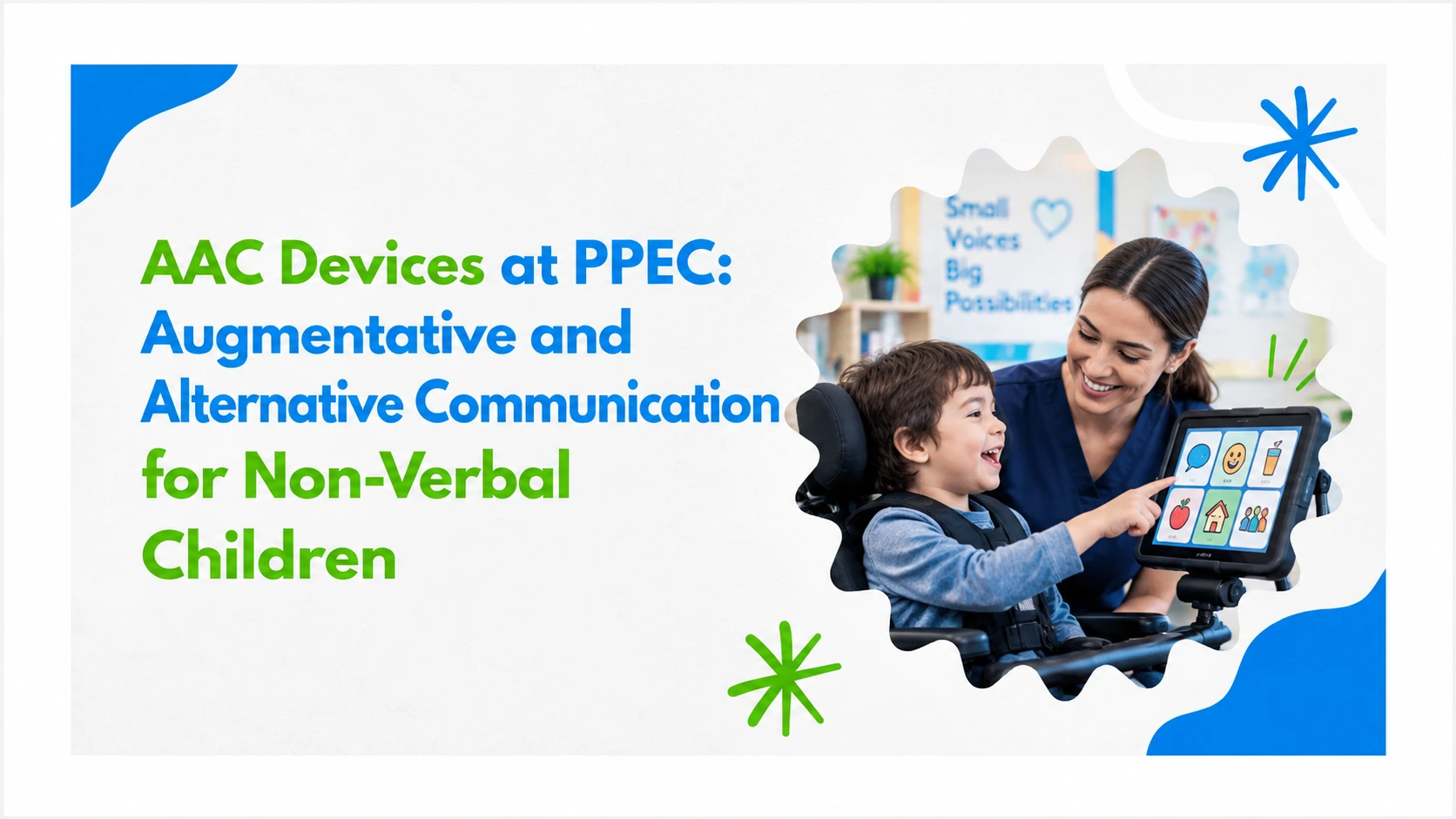
Watching a child struggle to communicate what they want or need is one of the harder experiences a parent can go through. It’s easy to feel like verbal speech is the only real measure of progress, and that anything else is a consolation prize. It isn’t for many children, a picture board, a switch, or a speech-generating device isn’t a fallback option. It’s the tool that finally lets them tell you what they’ve been trying to say all along.
At PPEC of Palm Beach, our speech-language pathologists work with children who use augmentative and alternative communication, commonly known as AAC, as a central and often life-changing part of their communication development. Our approach is built on assessing each child individually, choosing the right system for their specific needs, and making sure that system gets used consistently throughout the day to strengthen and develop non-verbal speech skills.
What AAC Actually Covers
Augmentative and alternative communication refers to any tool or method that supports or replaces spoken communication. The word augmentative means adding to a child’s existing speech, while alternative means providing another way to communicate when verbal speech isn’t reliable or available. AAC exists on a spectrum, from no-tech options like gestures, facial expressions, and manual signs, to low-tech tools such as picture communication boards and the Picture Exchange Communication System, up through high-tech speech-generating devices and tablet-based apps that produce spoken output.
Children who benefit from AAC include those with autism spectrum disorder, cerebral palsy, childhood apraxia of speech, genetic syndromes, and children who are nonverbal or minimally verbal for a variety of other reasons. Some children use AAC as their primary form of communication for life. Others use it temporarily while building spoken language, or alongside speech that isn’t yet reliable enough to be consistently understood.
Addressing the Concern Most Parents Have
One question comes up more than almost any other when AAC is first introduced: will giving my child a device stop them from ever learning to talk? It’s a completely understandable worry, but the research on this question is remarkably consistent. Introducing AAC does not delay or prevent speech development, and for many children, it actually supports it.
Children who are minimally verbal often experience real frustration trying to communicate without a reliable method, and that frustration itself can become a barrier to language growth. Giving a child an effective way to express themselves tends to reduce that frustration and, for many children, appears to support the development of speech alongside AAC use rather than in place of it. AAC is not a last resort. For children with complex communication needs, it’s considered a legitimate, evidence-based first-line approach, introduced early rather than after other options have been exhausted.
How PPEC Selects the Right System for Each Child
There is no single AAC system that works for every child, which is exactly why device selection at PPEC starts with a thorough, individualized evaluation rather than a default recommendation. Our speech-language pathologists assess a child’s current communication abilities, cognitive and language comprehension, motor skills, vision, and how they interact with different types of symbols or displays.
Motor ability plays a particularly important role in this process. A child with reliable hand control might do well with a touchscreen tablet using symbol-based vocabulary. A child with limited or inconsistent hand movement might need a device with larger, more widely spaced buttons, a switch-based access method, or even eye-gaze technology that allows them to select vocabulary just by looking at it. Getting this fit right matters enormously, because a system that’s technically capable but physically difficult for a child to operate reliably will end up being abandoned, no matter how sophisticated it is.
Once a few appropriate options are identified, PPEC therapists typically conduct trial periods with different systems, observing how a child engages with each one before recommending a specific device or approach. This trial process, along with the professional evaluation behind it, is also often necessary to support funding requests through insurance or state programs, since most speech-generating devices require this kind of documented process to be approved.
Getting a Device Isn’t the Finish Line
One of the more common misconceptions about AAC is that acquiring the device is the hard part, and that a child will simply start using it naturally once it arrives. In practice, learning to communicate through AAC is a skill that takes time, structured teaching, and a lot of consistent modeling from the people around a child.
The most well-supported strategy for teaching AAC use is something speech-language pathologists call aided language modeling, sometimes called aided language stimulation. It involves an adult using the child’s own AAC system to communicate alongside them, pointing to symbols or words on the device while speaking, rather than only expecting the child to use it independently. If a child is drinking juice, for example, the adult might point to the words “want more” on the device while saying the phrase out loud, modeling the exact process the child is eventually expected to use themselves. Children need extensive exposure to this kind of modeling before they can be expected to produce similar messages on their own, in much the same way children learn spoken language by hearing it constantly before they ever produce words themselves.
Making AAC Part of the Whole Day, Not Just Therapy Time
AAC systems only become effective communication tools when they’re available and actively used throughout a child’s entire day, not only during a scheduled speech therapy session. A device left in a bag or a communication board that only comes out for twenty minutes of practice will not build the kind of fluency a child needs to communicate their actual wants and needs in real time.
At PPEC, this is one of the clearest advantages of an all-day care setting. A child’s AAC system stays with them consistently, whether they’re eating lunch, playing, or participating in therapy sessions of any kind. Every member of the care team, not just the speech-language pathologist, is trained in that child’s specific system and is expected to model language on it and respond to the child’s attempts to communicate through it. A child working on requesting vocabulary practices that skill at snack time, during transitions, and throughout play, with support from everyone around them rather than only their assigned therapist.
What Progress With AAC Actually Looks Like
Progress with AAC doesn’t always look like what people expect. It’s rarely a straight line toward full sentences and independent device use. For many children, early progress looks like beginning to understand that pressing a symbol produces a predictable result, or reliably requesting a preferred item for the first time. From there, progress might mean combining two symbols together, expanding vocabulary to cover a wider range of needs and interests, or eventually building more complex sentence structures.
PPEC speech-language pathologists track this progress closely and adjust a child’s system and vocabulary as their skills grow. A device that was appropriately simple when a child started may need expanded vocabulary, a different screen layout, or additional features as their communication skills develop. This isn’t a one-time setup. It’s an ongoing process that evolves alongside the child.
Supporting Families in Using AAC at Home
AAC works best when it isn’t confined to PPEC. Families play an essential role in reinforcing a child’s communication system, and our speech-language pathologists work directly with parents and caregivers to build comfort and confidence using the device at home. This includes practical training on the system itself, guidance on modeling language during everyday routines, and support navigating the sometimes complicated process of funding, maintenance, or device updates.
If your child uses or is beginning to use an AAC system, know that learning to use it alongside them, even imperfectly, matters more than getting it exactly right. Children need to see their communication method being used and valued by the people closest to them, and that modeling is something families are uniquely positioned to provide outside of any therapy setting.
Conclusion
AAC gives children who cannot rely on speech a genuine, evidence-based path to communication, and for many families, it changes what’s possible in ways that are hard to overstate. At PPEC of Palm Beach, our speech-language pathologists are committed to finding the right system for each child, teaching it thoroughly, and supporting its use throughout every part of a child’s day. Reach out to learn more about how AAC assessment and support work for children in our care.
FAQs
Will using an AAC device stop my child from learning to talk?
No. Research consistently shows that AAC does not delay or prevent speech development. For many children, having a reliable way to communicate reduces frustration and can support the development of spoken language rather than replacing it.
How does PPEC decide which AAC system is right for my child?
Our speech-language pathologists evaluate a child’s communication abilities, cognitive skills, motor control, and vision, then trial a few appropriate systems to see how the child engages with each before recommending a specific device or approach.
My child has an AAC device, but doesn’t seem to use it much. Is that normal?
Yes, especially early on. Learning to use AAC takes consistent modeling and time, often through a technique called aided language modeling, where adults use the child’s system alongside.