
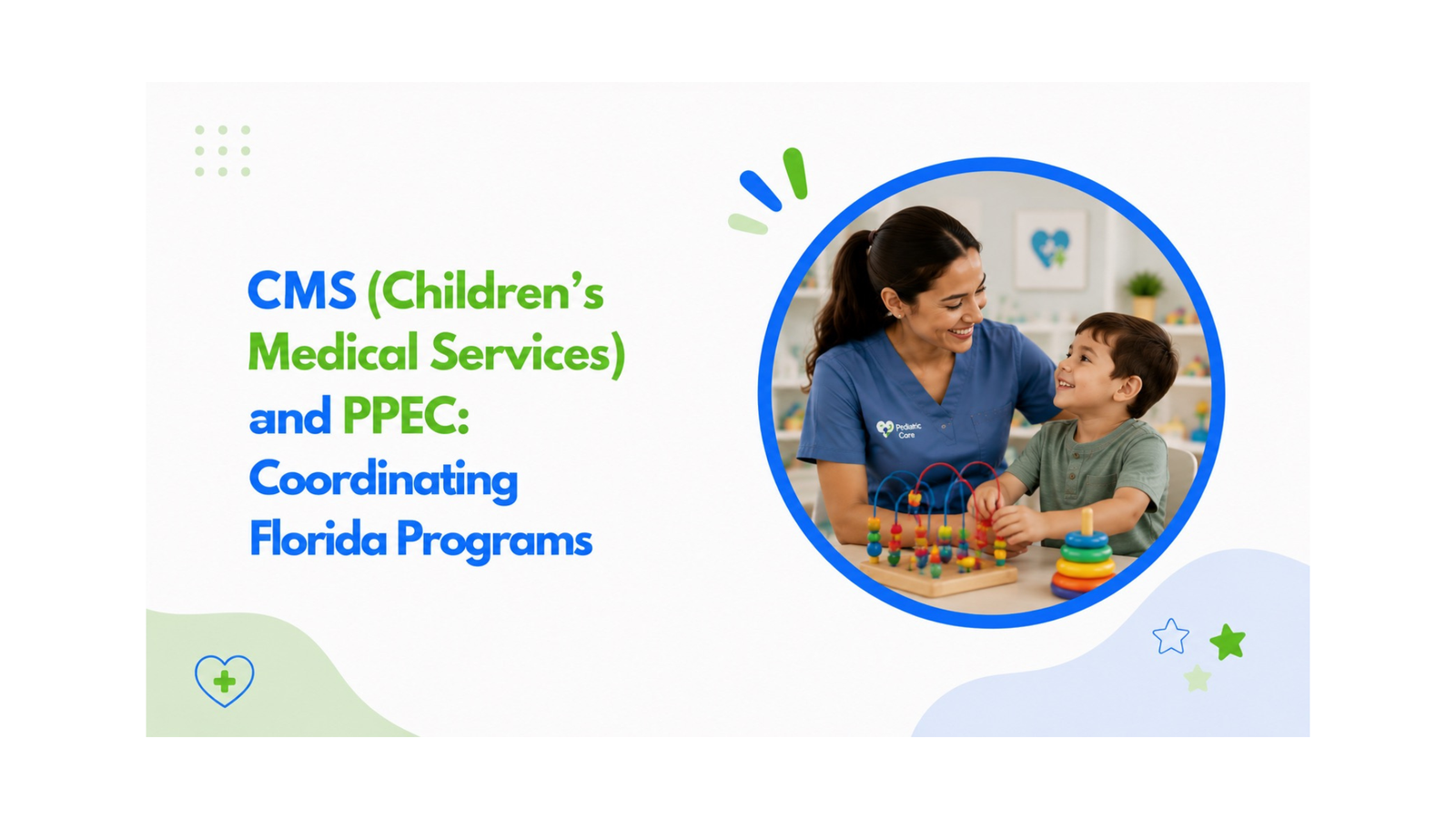
When you have a medically complex child in Florida, the landscape of programs, agencies, and funding sources can feel like an alphabet soup with no translation guide. CMS. PPEC. AHCA. Medicaid. Each one seems to operate in its own world, with its own forms, its own authorization processes, and its own set of people to call when something isn’t clear.
However, these programs are not meant to compete with each other. They are designed to work together, and when they do, the combination of Florida’s Children’s Medical Services and Prescribed Pediatric Extended Care creates one of the most comprehensive support structures available to families of medically fragile children in the state. Understanding how these two programs interact, overlap, and complement each other is the key to ensuring your child receives everything they are entitled to.
What Is Children’s Medical Services (CMS)?
Children’s Medical Services is a Florida Department of Health program specifically designed to serve children with special health care needs. It is not a single program but a collection of programs,a statewide network of specially qualified physicians, nurses, therapists, and care coordinators who provide family-centered care for children with complex, chronic health conditions.
CMS serves children from birth through age 20 who have serious or chronic physical conditions that require care beyond what standard pediatric practice provides. The program’s defining characteristic is its care coordination model: a CMS care coordinator serves as a central point of contact for the child’s entire care team, helping families navigate the often complex intersection of medical providers, specialists, therapies, insurance, and community support programs.
CMS services may include:
- Access to a statewide network of CMS-approved physicians and specialists
- Dedicated care coordination through an assigned CMS care coordinator
- Assistance navigating Medicaid managed care and accessing covered services
- Support with referrals to specialty providers, therapies, and community programs
- Family education, training, and support resources
- Transition planning as children approach adulthood
Enrollment in CMS requires that a child have a qualifying condition, be a Florida resident, and meet the program’s medical eligibility criteria. Many children with complex medical needs who are already enrolled in Medicaid are simultaneously eligible for CMS services
What Is PPEC?
Prescribed Pediatric Extended Care (PPEC) is a licensed, facility-based medical daycare program providing comprehensive daytime care for medically fragile children from birth until age 21. Governed by Florida’s Agency for Health Care Administration (AHCA) and covered by Florida Medicaid, PPEC programs are licensed under Chapter 400 Part VI of Florida Statutes and regulated under Chapter 59A-13 of the Florida Administrative Code.
In a PPEC program, medically complex children receive up to 12 hours per day of:
- Continuous skilled nursing care delivered by licensed RNs and LPNs.
- Integrated physical, occupational, speech and feeding, and behavioral therapy.
- Individualized developmental programming.
- Medical equipment management.
- Care coordination and family support.
PPEC is not simply daycare with a nursing component; it is a fully licensed healthcare facility specifically built for children whose medical complexity requires clinical oversight throughout the day. Prior authorization for PPEC services is managed through AHCA’s designated utilization management partner, which reviews each child’s clinical documentation to confirm medical necessity before services begin.
How CMS and PPEC Work Together
CMS and PPEC are complementary programs that address different dimensions of a medically complex child’s care. Understanding where each program begins and ends, and where they overlap, is what allows families to maximize the support their child receives.
CMS Provides the Coordination; PPEC Provides the Daily Care
Think of CMS as the structural framework and PPEC as the daily clinical environment. CMS care coordinators help families navigate the full system, connecting them with specialists, ensuring Medicaid coverage is optimized, and helping families access programs like PPEC that they might not otherwise know about. PPEC, meanwhile, is the program where a child physically spends their day, receiving continuous nursing, therapy, and developmental support within a licensed clinical setting.
A child enrolled in both programs has a CMS care coordinator actively working on their behalf at the system level while the PPEC nursing and therapy team manages their daily clinical and developmental needs. These are not redundant functions; they are complementary ones.
CMS Care Coordinators Can Facilitate PPEC Enrollment
One of the most practical intersections between CMS and PPEC is the enrollment process. CMS care coordinators are often the professionals who first identify that a child qualifies for PPEC and guide families through the initial steps of enrollment. They can assist with gathering required medical documentation, coordinating with the child’s physician on the PPEC prescription, and navigating the Medicaid prior authorization process through Acentra Health.
For families who are overwhelmed by the administrative complexity of PPEC enrollment, having a CMS care coordinator actively assisting is one of the most valuable resources available. If your child is enrolled in CMS and you are considering PPEC, your care coordinator is the right first contact.
CMS and PPEC Therapy Billing Coordinates Through Medicaid
For families whose children receive therapy services through both CMS and PPEC, understanding how billing is coordinated matters practically. Florida Medicaid PPEC and CMS therapy claims are billed on the CMS 1500 form, with separate billing processes for PPEC daycare component codes and CMS therapy services. PPEC providers and CMS therapy providers each submit claims through their respective authorization structures, and Medicaid coordinates coverage across both programs.
In practical terms, this means families do not need to choose between CMS therapy services and PPEC therapy services; the two can be coordinated. However, to avoid duplication and ensure appropriate coverage, the PPEC clinical team and the CMS care coordinator must communicate directly about which therapy services are being provided in each setting and how goals are aligned across them.
Shared Goals, Shared Documentation
The strongest CMS and PPEC partnerships are those where clinical information flows freely between the two programs. A CMS care coordinator who is regularly updated by the PPEC nursing team can more effectively advocate for the child at the system level, whether that means pursuing additional Medicaid authorizations, coordinating with a specialist whose involvement has been recommended by the PPEC team, or connecting the family with community resources that address needs the PPEC program has identified.
Conversely, a PPEC nursing and therapy team that is aligned with the child’s CMS-coordinated medical goals can ensure that daily programming reflects the broader clinical priorities established by the child’s specialist team, rather than operating in isolation from the rest of the child’s care system.
What This Looks Like for a Palm Beach Family
Consider a child in Palm Beach with a tracheostomy, complex epilepsy, and significant developmental delays across motor, communication, and behavioral domains. This child is enrolled in Florida Medicaid, qualifies for CMS, and has been prescribed PPEC services by their neurologist and pulmonologist.
Here is what a well-coordinated CMS and PPEC structure looks like for this family:
- The CMS care coordinator maintains an overview of the child’s full care team, neurologist, pulmonologist, developmental pediatrician, and PPEC, ensuring that each provider has current information and that Medicaid authorizations are in place for all services. When the pulmonologist recommends a change in ventilator settings, the care coordinator ensures the PPEC team receives updated orders promptly.
- The PPEC nursing team manages the child’s tracheostomy, implements the physician-prescribed seizure protocol, administers medications on schedule, and monitors cardiorespiratory status continuously throughout the program day. When a seizure pattern changes or a new respiratory concern emerges, the nursing team notifies the family and coordinates with the CMS care coordinator to facilitate a specialist appointment.
- The PPEC therapy team delivers physical, occupational, speech, and behavioral therapy daily, working toward the developmental goals established in coordination with the family and the child’s developmental pediatrician. Progress notes are shared with the CMS care coordinator, who incorporates them into the child’s overall care record.
- The family receives daily reports from the PPEC team, has a clear point of contact in their CMS care coordinator for system-level questions, and, for the first time in this child’s life, has the clinical infrastructure in place to return to work, knowing their child is genuinely, comprehensively supported.
This is not a hypothetical model. It is what coordinated CMS and PPEC care looks like when both programs are operating as they are designed to.
Important Program Details Florida Families Should Know
PPEC Reassessments Occur Every 180 Days
Florida Medicaid requires reassessment of PPEC eligibility every 180 days to verify continued medical necessity. Families should be aware of these reassessment timelines and ensure that their child’s physician documentation is updated accordingly. The PPEC of Palm Beach enrollment and care coordination team manages this process and notifies families when reassessments are approaching.
Prior Authorization Is Managed Through Acentra Health
PPEC services in Florida require prior authorization through Acentra Health (formerly eQHealth Solutions), AHCA’s designated utilization management partner. This authorization reviews clinical documentation to confirm medical necessity before services begin and must be renewed at reassessment intervals. PPEC of Palm Beach manages this process on behalf of enrolled families.
CMS Enrollment Is Separate From Medicaid Enrollment
Having Medicaid does not automatically enroll a child in CMS. Families must apply for CMS separately through the Florida Department of Health. Children with complex medical needs who qualify for Medicaid should also be evaluated for CMS eligibility; the two programs are not redundant, and accessing both provides substantially more comprehensive support than either one alone.
Florida KidCare (CHIP) Members Have Specific Billing Considerations
For children enrolled in Florida KidCare (Title 21 CHIP) rather than standard Medicaid, PPEC daycare component codes are billed directly to Acentra Health rather than through the managed care plan. Families enrolled in KidCare should confirm their child’s specific PPEC billing structure with the PPEC of Palm Beach enrollment team to ensure services are authorized and billed correctly from the start.
How to Access Both Programs in Palm Beach
If your child is not yet enrolled in CMS or PPEC, or if you are enrolled in one but not the other, here are the steps to access both programs:
To enroll in CMS: Contact the Florida Department of Health’s Division of Children’s Medical Services. CMS enrollment requires documentation of your child’s qualifying condition and Florida residency. Your child’s pediatrician or specialist can provide a referral, or you can contact the CMS program directly through the Florida Department of Health’s website.
To enroll in PPEC of Palm Beach: Contact the PPEC of Palm Beach enrollment team directly. The team will assess your child’s eligibility, assist with obtaining the required physician’s prescription, manage the Medicaid prior authorization process through Acentra Health, and guide you through every step from initial inquiry to your child’s first day.
To coordinate both programs: Introduce your CMS care coordinator to the PPEC of Palm Beach clinical team early in the enrollment process. Establish a shared communication structure, whether through regular care coordination calls, shared documentation, or a designated point of contact on each side, that ensures both programs are working from the same clinical priorities and the same goals for your child.
Conclusion
CMS and PPEC are two of the most powerful programs available to families of medically complex children in Florida, and they are most powerful when they work together. CMS provides the coordination framework that keeps a child’s entire care system aligned. PPEC provides the daily clinical environment where skilled nursing, integrated therapy, and developmental support are delivered with consistency and expertise.
At PPEC of Palm Beach, we are experienced in coordinating with CMS care coordinators, navigating the Medicaid authorization structures that govern both programs, and ensuring that families receive the full benefit of everything Florida’s medical support system offers. If your child is eligible for PPEC and you’re ready to explore enrollment, with or without existing CMS enrollment, reach out to our team. We’ll help you understand every program available to your child and make sure nothing falls through the cracks.