
Watch a child reach for a cup, climb a step, or catch a ball, and what looks effortless is actually the result of dozens of coordinated processes happening simultaneously. The brain sends signals. Muscles activate in precise sequences. The eyes track movement and inform the hands. Balance shifts to accommodate the new position. All of it happens in fractions of a second, automatically, invisibly, and only because the brain has learned, through thousands of repetitions, exactly how to plan and execute that movement.
For many children in PPEC programs, this process, called motor planning, doesn’t happen automatically. It requires deliberate, expert support. And at PPEC of Palm Beach, supporting motor planning through structured, individualized coordination exercises is one of the most meaningful things our physical and occupational therapy teams do every single day.
Here is what motor planning is, why it matters for medically complex children, and how our coordination exercises help children build the movement foundations that shape every dimension of their daily lives.
What Is Motor Planning?
Motor planning, also called praxis, is the brain’s ability to conceptualize, organize, and execute an unfamiliar or complex sequence of movements. It is the cognitive-physical bridge between intending to do something and actually doing it smoothly and effectively.
Motor planning involves three distinct stages:
- Ideation: Forming the idea of what movement to perform
- Planning: Organizing the sequence of steps the body needs to execute that movement
- Execution: Carrying out the planned movement in a coordinated way
When motor planning works well, a child can pick up a crayon, position it correctly in their hand, and draw a circle, all without consciously thinking through each individual component. When motor planning is disrupted by neurological conditions, sensory processing differences, developmental delays, or the effects of prematurity or genetic syndromes, the same task can feel effortful, frustrating, and inconsistent.
Children with motor planning difficulties often appear clumsy, avoid new physical activities, have difficulty learning motor sequences, or show significant variability in their performance, doing something well one day and struggling with the same task the next. These are not behavioral issues or lack of effort. They are the observable result of a neurological process that needs clinical support to develop.
Why Motor Planning Matters for Medically Complex Children
For children in PPEC programs, motor planning challenges are not isolated developmental concerns; they are deeply connected to the underlying conditions that brought the child to PPEC in the first place.
Cerebral palsy affects the motor cortex and cerebellum, disrupting the neurological pathways that coordinate movement planning and execution. Genetic syndromes often involve low muscle tone, which affects the proprioceptive feedback system that motor planning relies on. Premature birth can result in disrupted cerebellar development, directly affecting coordination and motor sequencing. Sensory processing differences, common across the PPEC population, affect the sensory inputs that the brain uses to plan and adjust movement in real time.
How Coordination Exercises Support Motor Planning Development
Coordination exercises build motor planning capacity through a principle that applies equally in pediatric therapy and elite athletic training: the brain learns movement through repetition, sensory feedback, and progressive challenge. Every time a child attempts, adjusts, and completes a coordinated movement, the neural pathways supporting that movement become more efficient and more reliable.
At PPEC of Palm Beach, coordination exercises are delivered through a multidisciplinary approach that includes occupational and physical rehabilitation. Our peach pit therapy approach focuses on helping children improve balance, coordination, strength, mobility, and functional movement through personalized activities that match each child’s developmental needs and abilities.
The general principles that guide effective coordination exercises for children include:
- Repetition of targeted movements to build the motor engrams, the neural movement patterns that allow skills to become automatic.
- Use of multisensory cues, including tactile, visual, and proprioceptive feedback, to enhance the brain’s ability to plan and correct movement in real time.
- Progressive challenge, gradually increasing complexity and speed as earlier movement patterns are consolidated.
- Breaking movements into components that are achievable at the child’s current level, building toward the full movement sequence.
- Integration into meaningful activity so that motor planning is practiced in the contexts that matter most to each child’s daily life.
At PPEC of Palm Beach, these principles are applied within an individualized framework, meaning that no two children’s coordination programs look identical, because no two children have the same motor planning profile, the same underlying conditions, or the same developmental priorities.
Types of Coordination Exercises Used at PPEC of Palm Beach
Gross Motor Coordination Activities
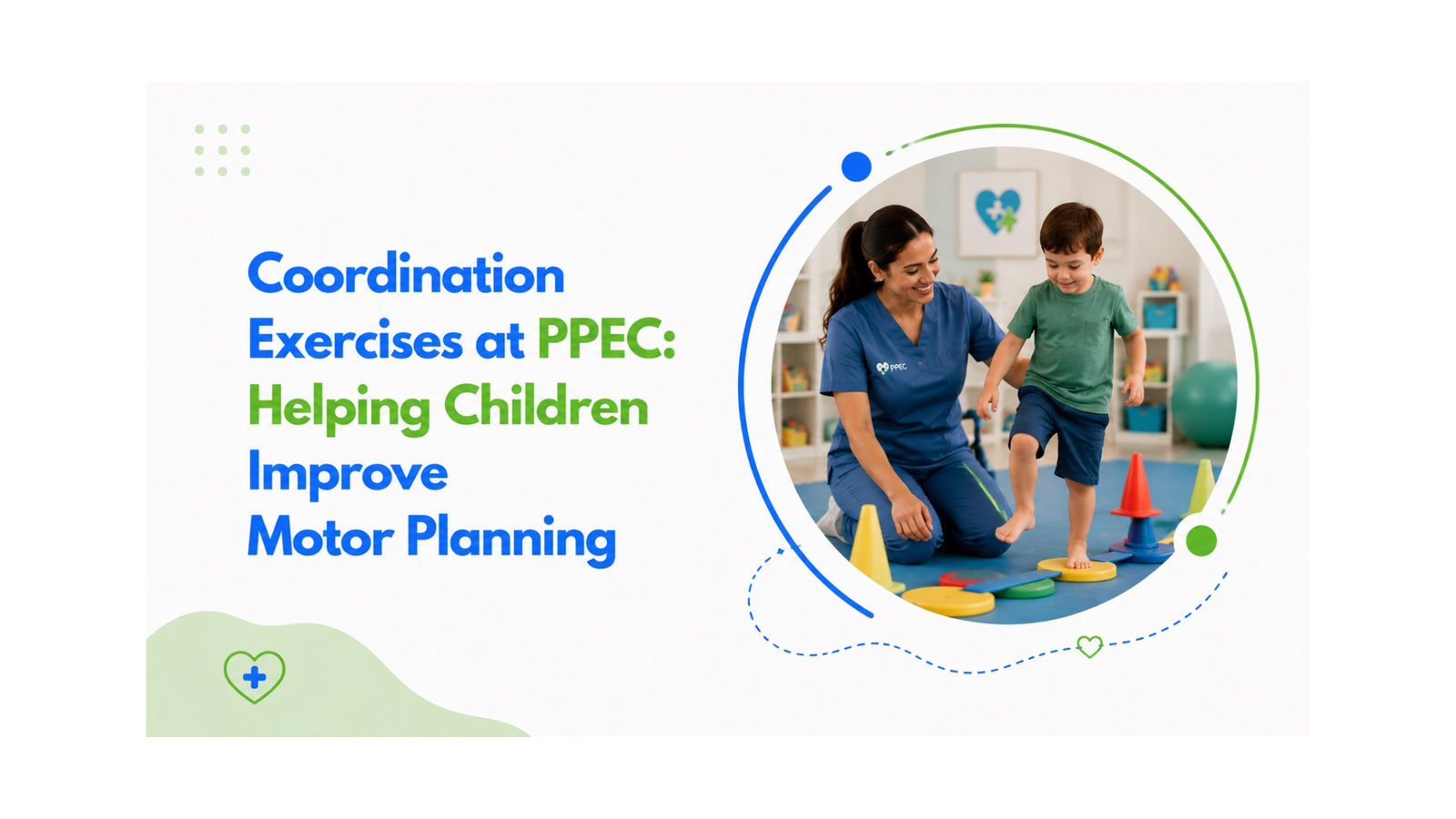
Gross motor coordination exercises address the large-scale, whole-body movements that underpin everything from sitting stability to walking to playground play. For medically complex children, these activities are carefully calibrated to each child’s physical capacity and medical parameters.
Common gross motor coordination activities include:
- Cross-lateral movements, such as bringing the opposite knee and elbow together, which build the interhemispheric brain communication that supports coordinated whole-body movement and lays the foundations for reading and writing
- Balance challenges, including single-leg standing, balance beam walking, and weight-shifting activities that build the postural stability motor planning depends on
- Controlled jumping and landing, progressed from jumping off a low step with two feet to more complex jumping patterns as stability develops
- Resistive band exercises, which provide proprioceptive input while building the strength and coordination that make controlled movement possible
- Standing marches and walking lunges, which develop hip stability, weight transfer, and the coordinated alternating movement patterns used in all functional mobility
For children with significant physical limitations, these activities are adapted to supported seated or standing positions, using adaptive activities equipment to provide the stability that allows therapeutic movement to happen safely.
Fine Motor Coordination Activities
Fine motor coordination exercises address the precise, controlled hand and finger movements that children need for self-feeding, dressing, play, and pre-academic skills. For children with motor planning difficulties, fine motor tasks are particularly challenging because they require complex, multi-step movement sequences executed in small, rapid motions.
Effective fine motor coordination activities include:
- Bilateral coordination tasks such as cutting with scissors, stringing beads, or opening containers, which require both hands to work together in coordinated, differentiated roles.
- Hand-eye coordination activities such as catching and throwing balls of varying sizes, pegboard tasks, and threading activities that build the visual-motor integration motor planning relies on.
- Graded grasping and manipulation tasks, progressed from larger, easier-to-grasp objects to smaller, more precise manipulation as hand strength and coordination develop.
- Tool use practice, including spoon and fork use, crayon grasp, and age-appropriate self-care tools that make coordination practice functionally meaningful.
- Play-dough and resistive putty activities, which build hand strength and intrinsic muscle development while providing rich proprioceptive feedback that enhances motor planning.
Sensory-Motor Integration Activities
Because motor planning depends on the quality of sensory information the brain receives from the body and the environment, sensory-motor integration activities are a critical component of coordination programming for medically complex children. These activities simultaneously address sensory processing and motor execution, building both the sensory foundation and the movement capacity that functional coordination requires.
Sensory-motor integration activities at PPEC include:
- Proprioceptive input activities such as pushing weighted carts, carrying heavy objects, and resistive pulling tasks that deepen the body awareness motor planning depends on.
- Vestibular activities such as controlled swinging, rocking, and spinning (within each child’s medical and sensory tolerance), which develop the balance and spatial orientation systems that coordinate movement.
- Tactile exploration activities that build sensory tolerance and the tactile discrimination skills that allow hands to “know” what they are holding without looking.
- Movement sequences in varied sensory contexts, practicing the same motor skills across different sensory environments to build the flexible motor planning that transfers to real-world situations.
Rhythmic and Music-Based Movement
Rhythm is one of the most powerful tools available for motor planning development in children. Movement synchronized to a predictable rhythm builds timing, sequencing, and the ability to initiate and stop movement at precise moments, all of which are core motor planning skills.
At PPEC of Palm Beach, rhythmic activities integrated into coordination programming include:
- Drumming and musical instrument play, building hand coordination, bilateral symmetry, and sequencing within an engaging, motivating activity.
- Structured movement to music, using familiar songs to cue movement patterns that children can anticipate and prepare for.
- Clapping and tapping sequences, building rhythmic coordination from simple patterns to more complex bilateral sequences.
- Dance and movement activities, adapted for every level of physical ability, provide full-body coordination practice within a socially engaging and joyful context.
How Integration Makes Coordination Exercises More Effective
One of the most important features of coordination programming at PPEC of Palm Beach is that it doesn’t happen in isolation. The coordination goals established by physical and occupational therapists are embedded into every appropriate moment of the child’s day, not just during formal therapy sessions.
A child working on bilateral hand coordination practices those skills during art projects and self-feeding, not only during occupational therapy. A child building balance and postural control uses supported standing positions throughout the day, with nursing staff maintaining the positioning goals established by the physical therapist. In a PPEC medical daycare, this close collaboration between skilled nursing and therapy professionals ensures children receive consistent support that reinforces motor development throughout the day.
What Families Can Do at Home
Coordination development doesn’t stop at pickup. Families play a vital role in extending the work of PPEC’s therapy team into the hours children spend at home, and the PPEC occupational and physical therapy teams provide specific, actionable home strategies to make this possible.
Simple daily activities that reinforce motor planning at home include:
- Letting children do things themselves, even slowly, fastening buttons, spooning their own food, carrying their bag, because self-initiated movement builds motor planning more powerfully than assisted movement
- Floor play, which builds core strength, weight shifting, and the postural foundations that all coordination depends on
- Ball play at every level, rolling, catching, kicking, adapting to your child’s current abilities and progressively challenging them as skills develop
- Obstacle courses, using cushions, steps, and household furniture to build the motor planning required to navigate varied physical environments
- Following movement instructions in play, such as simple action songs or movement games that require children to plan and sequence whole-body movements in response to verbal cues
Your child’s PPEC therapists will tailor these suggestions to your child’s specific motor planning profile and current level, so that home practice reinforces program goals rather than working at cross-purposes with them.
Conclusion
Motor planning is the invisible architecture behind every movement a child makes. At ppec palm beach, children with medically complex conditions receive individualized therapy, skilled nursing support, and developmental care within a specialized pediatric day health setting. By combining these services with structured coordination exercises, children can strengthen motor skills, gain confidence, and build greater independence in their everyday lives.
At PPEC of Palm Beach, our physical and occupational therapy teams bring that expertise to coordination programming every single day, designing exercises that meet each child where they are, challenge them appropriately, and embed motor planning practice into every meaningful moment of the program day. The goal is not just a child who can complete a coordination exercise in therapy. It is a child who moves through their world with increasing confidence, independence, and capability.
If your child has motor planning challenges and you’d like to learn how PPEC of Palm Beach’s integrated therapy approach can support their development, reach out to our team. We’d love to talk about what coordination programming can look like for your child specifically.
FAQs
What is motor planning and why is it important for children?
Motor planning, or praxis, is the brain’s ability to conceptualize, organize, and execute a complex sequence of movements. It underlies every functional motor skill from self-feeding to handwriting to playground play. For medically complex children, motor planning is often affected by neurological conditions, sensory processing differences, low muscle tone, or prematurity, making targeted coordination exercises an essential component of developmental support.
What types of coordination exercises does PPEC of Palm Beach use?
PPEC of Palm Beach uses gross motor coordination activities such as cross-lateral movements and balance challenges, fine motor coordination tasks including bilateral hand activities and tool use, sensory-motor integration activities providing proprioceptive and vestibular input, and rhythmic and music-based movement exercises. All activities are individually tailored to each child’s motor planning profile, physical capacity, and medical parameters.
How do physical and occupational therapists work together on coordination at PPEC?
Physical and occupational therapists at PPEC share documentation and coordinate on each child’s motor planning goals, with PT focusing on gross motor coordination, balance, and mobility, and OT addressing fine motor coordination, sensory processing, and daily living skills. Both therapy teams embed their goals into daily programming so that coordination practice is reinforced throughout the entire program day, not just during formal therapy sessions.
How long does it take to see improvement in motor planning with coordination exercises?
Progress in motor planning varies based on the child’s underlying conditions, the severity of the coordination challenge, the consistency of therapy and home practice, and the child’s age at the time intervention begins. Early, consistent, and well-integrated therapy produces the strongest outcomes. Many families begin to notice meaningful improvements in motor skills and functional independence within the first few months of coordinated programming.
How can I support my child’s motor planning development at home?
PPEC of Palm Beach’s therapy team provides specific home strategies tailored to each child’s motor planning goals. General approaches include encouraging independent self-care tasks, providing floor play opportunities, incorporating ball play and obstacle courses, and using action songs and movement games that require motor sequencing.