
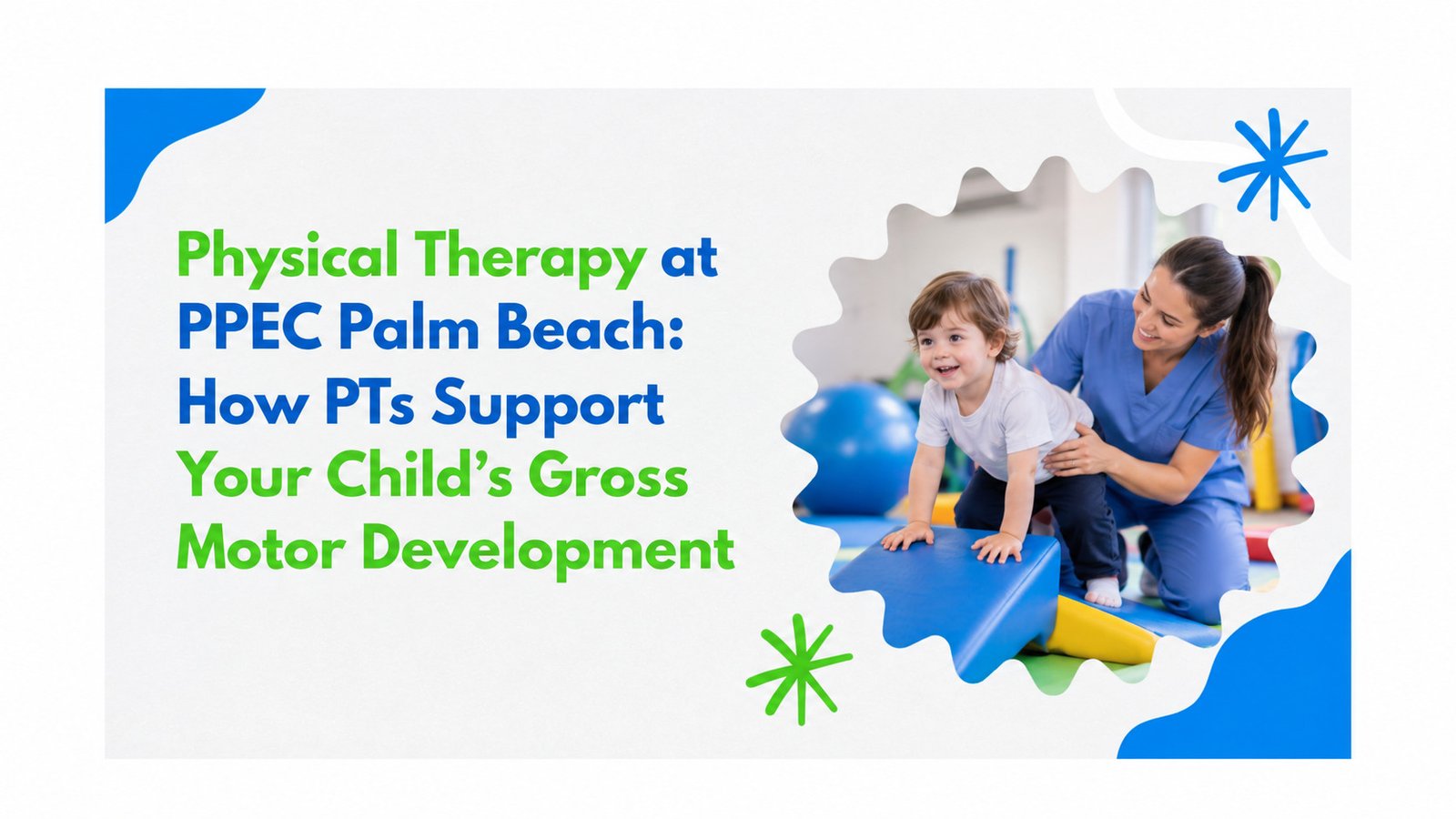
For a lot of parents, watching their toddler take those first wobbly steps is a moment they don’t think twice about. For you, it might mean something different. Maybe it’s a moment you’ve waited longer for, worked harder for, or weren’t sure would come the way it did for other kids. And that’s okay. Every child’s path to standing, walking, and moving through the world looks different.
Here’s what’s happening underneath those milestones: the brain coordinates dozens of muscles at once, the inner ear works out balance, and the body learns to track where arms and legs are in space. For children with medical complexity or developmental delays, that process can need extra support to come together, and that’s exactly what physical therapy is there for.
At PPEC Palm Beach, our physical therapists work alongside your child and you to build the strength, coordination, and confidence behind these milestones, at whatever pace is right for them.
What Is Pediatric Physical Therapy?
Pediatric physical therapy focuses on the assessment, treatment, and management of children with conditions that impact their physical development and functional mobility. Unlike adult physical therapy, which commonly addresses injury rehabilitation, pediatric physical therapy is focused on developmental goals and milestones. Its purpose is to help a child build the foundations for movement that they use for the rest of their life.
Pediatric physical therapists are licensed professionals with specialized training in child development, neurological conditions affecting movement, musculoskeletal assessment, and adaptive strategies that help children with physical limitations participate as fully as possible in daily life. At PPEC of Palm Beach, physical therapists work as integrated members of each child’s clinical care team, collaborating with licensed nurses, occupational therapists, speech therapists, and the child’s physician to ensure physical therapy goals are embedded into every appropriate moment of the program day.
What Is Gross Motor Development and Why Does It Matter?
Gross motor development refers to the progression of skills involving the large muscle groups: holding the head up, rolling, sitting, crawling, standing, walking, running, and navigating the physical environment with increasing independence. Each milestone builds on the foundations laid by those before it. When any step in this sequence is delayed or disrupted, this may affect movement and the cognitive, social, and language development that depends on a child being able to explore their environment and interact with the world.
Key gross motor milestones across early childhood include:
| Age | Key Milestones |
| 0 to 3 months | Lifts head on stomach, stretches and kicks |
| 3 to 6 months | Rolls to sides, sits with support, bears weight on legs |
| 6 to 9 months | Sits independently, rolls both ways, begins crawling |
| 9 to 12 months | Pulls to stand, cruises furniture, may take first steps |
| 12 to 18 months | Walks independently, begins climbing |
| 2 to 3 years | Jumps with both feet, climbs stairs, runs |
| 3 to 5 years | Hops, skips, stands on one foot, catches a ball |
For children with special needs, delays in reaching these milestones are common. Physical therapy helps those with delays to reach these milestones with early, consistent intervention.
Children Who Benefit From Physical Therapy at PPEC
Physical therapy at PPEC of Palm Beach supports children across a wide range of diagnoses, including:
- Cerebral palsy, affecting motor control, muscle tone, posture, and movement patterns
- Prematurity and birth-related complications, resulting in delayed motor milestone acquisition
- Genetic and chromosomal syndromes such as Down syndrome, typically involving low muscle tone and joint laxity
- Neuromuscular conditions such as spinal muscular atrophy, muscular dystrophy, and spina bifida
- Traumatic brain injury and acquired neurological conditions requiring rehabilitation and compensatory movement strategies
- Medical fragility with prolonged hospitalization, where restricted movement creates motor delays regardless of the underlying diagnosis
- Developmental motor delays where milestones are not achieved on the expected timeline
What Pediatric Physical Therapists Do at PPEC
Evaluation and Goal Setting
Every child’s physical therapy journey begins with a comprehensive evaluation assessing functional mobility, muscle strength and tone, range of motion, balance, postural control, coordination, and gross motor milestone level. This evaluation is the foundation of each child’s individualized therapy plan and is repeated at regular intervals to track progress and update goals.
Therapy plans are individualized in every meaningful sense. Goals are specific to each child’s baseline, interventions are selected for their clinical relevance to the child’s diagnosis, and the progression of challenge is paced to each child’s response. No two children at PPEC of Palm Beach have the same physical therapy plan.
Fundamental Interventions and Techniques
Physical therapists at PPEC use a range of evidence-based approaches tailored to each child’s clinical profile:
Therapeutic Handling and Facilitation
Hands-on techniques using neurodevelopmental treatment (NDT) principles, in which the therapist uses specific manual handling to facilitate normal movement patterns, reduce the influence of abnormal tone, and help the child experience more efficient ways of moving.
Strengthening and Postural Training
Targeted exercise progressions that build core stability, hip strength, and lower extremity strength through play-based activities. Balance training using therapeutic balls, varied surfaces, and balance boards builds the automatic postural responses that mobility and movement independence depend on.
Gait Training
For children developing walking skills, gait training uses assisted walking, weight-bearing activities, specialized equipment, and parallel bars to develop the weight-shifting, step initiation, and balance recovery skills that independent walking requires.
Tummy Time and Developmental Floor Activities
Structured tummy time and floor-based activities build the head control, upper extremity weight bearing, and core activation that are the foundation of all subsequent gross motor development.
Adaptive Equipment Assessment and Training
One of the most practically impactful roles the physical therapist plays at PPEC is assessing each child’s need for adaptive mobility and positioning equipment. Equipment commonly assessed, prescribed, and trained includes:
- Standing frames: Providing supported upright weight bearing for children who cannot stand independently, supporting bone density, hip development, and range of motion alongside neurological benefits
- Gait trainers and walkers: Assistive devices that allow children with insufficient strength or balance for independent walking to experience and practice supported locomotion
- Ankle-foot orthoses (AFOs) and other orthotics: Managing foot and ankle alignment to optimize weight bearing and gait efficiency
- Wheelchairs and positioning systems: Ensuring correct seating posture and pressure management for children requiring wheeled mobility
The physical therapist does not simply prescribe equipment. They train the child to use it effectively, brief the PPEC care team on correct use throughout the program day, and provide families with guidance to ensure consistency across all environments.
How Physical Therapy Integrates Into the Full Program Day
One of the most significant advantages of physical therapy within a PPEC program compared to outpatient physical therapy clinic visits is the opportunity for therapeutic goals to be embedded into the entire program day. At PPEC of Palm Beach, the physical therapist communicates positioning goals, activity recommendations, and movement opportunities to the nursing and care team, ensuring that the work of physical therapy extends beyond scheduled sessions.
A child working on supported standing has standing frames incorporated into routine activities. A child developing crawling transitions has floor time embedded into the daily schedule. A child building walking endurance practices functional walking in transitions between areas of the facility rather than only in the therapy room. This daily repetition across varied, meaningful contexts accelerates motor skill development significantly beyond what weekly clinic appointments alone can produce, because the brain builds motor skills through repetition embedded in real-life situations.
Home Programs: Extending Therapy Beyond PPEC
At PPEC of Palm Beach, physical therapists develop individualized home programs for every family, providing specific activities, handling techniques, and positioning strategies that reinforce therapy goals during the hours a child is at home. These programs are designed to fit within a typical family’s daily routine using everyday activities such as bathtime, floor play, dressing, and mealtimes as natural opportunities to practice the movement patterns and positions that support physical therapy goals. Home programs are reviewed and updated regularly to stay aligned with the child’s current development.
When to Seek Pediatric Physical Therapy
If your child has not yet been evaluated by a pediatric physical therapist and you have concerns about gross motor development, early action is important. Early intervention consistently produces stronger and more durable outcomes than therapy begun later. Signs that a physical therapy evaluation may be warranted include:
- Gross motor milestones significantly delayed relative to the age ranges above
- Asymmetrical movement patterns such as consistent preference for one side
- Unusually high or low muscle tone interfering with movement
- Difficulty maintaining positions against gravity such as sitting or standing
- Significant joint stiffness, contractures, or limited range of motion
- Abnormal gait patterns or difficulty walking safely
- Regression in previously acquired motor skills
For children enrolled at PPEC of Palm Beach, physical therapy evaluation is initiated as part of the intake process. Families with concerns are encouraged to reach out to the PPEC team directly to discuss their child’s situation.
Conclusion
Gross motor development is the platform on which a child’s ability to explore, learn, connect, and participate in the world is built. For medically complex children, building that platform requires expert, consistent, and individualized pediatric physical therapy delivered within a clinical environment that supports therapeutic work throughout every program hour. At PPEC of Palm Beach, our pediatric physical therapists work within an integrated care team to ensure that gross motor goals are embedded into the fabric of each child’s day. Reach out to learn how our physical therapy program can support your child’s development.
FAQs
What does a pediatric physical therapist do at PPEC?
Pediatric physical therapists at PPEC of Palm Beach evaluate each child’s functional mobility, muscle strength and tone, balance, coordination, and gross motor milestone level. They develop individualized therapy plans, deliver targeted interventions, assess and train children in adaptive equipment use, and embed physical therapy goals into the child’s full program day in coordination with the nursing and therapy team.
How is physical therapy at PPEC different from outpatient physical therapy?
Outpatient physical therapy clinic appointments deliver therapy in isolated sessions, typically one to three times per week. At PPEC of Palm Beach, physical therapy goals are integrated into the full program day through positioning, transitions, activities, and daily routines supported by the entire care team. This daily repetition across meaningful contexts accelerates motor skill development significantly beyond what clinic sessions alone can produce.
What adaptive equipment might my child need through physical therapy?
Depending on your child’s motor profile, the PPEC physical therapist may assess for standing frames, gait trainers, walkers, ankle-foot orthoses, wheelchairs, or other positioning systems. The physical therapist manages the assessment, recommendation, fitting coordination, and training for both the child and the care team.
How do I know if my child needs pediatric physical therapy?
If your child has delayed gross motor milestones, asymmetrical movement, unusually high or low muscle tone, limited range of motion, difficulty maintaining positions, abnormal gait, or regression of previously acquired motor skills, a pediatric physical therapy evaluation is warranted. Reach out to the PPEC of Palm Beach team to discuss your child’s specific situation.