
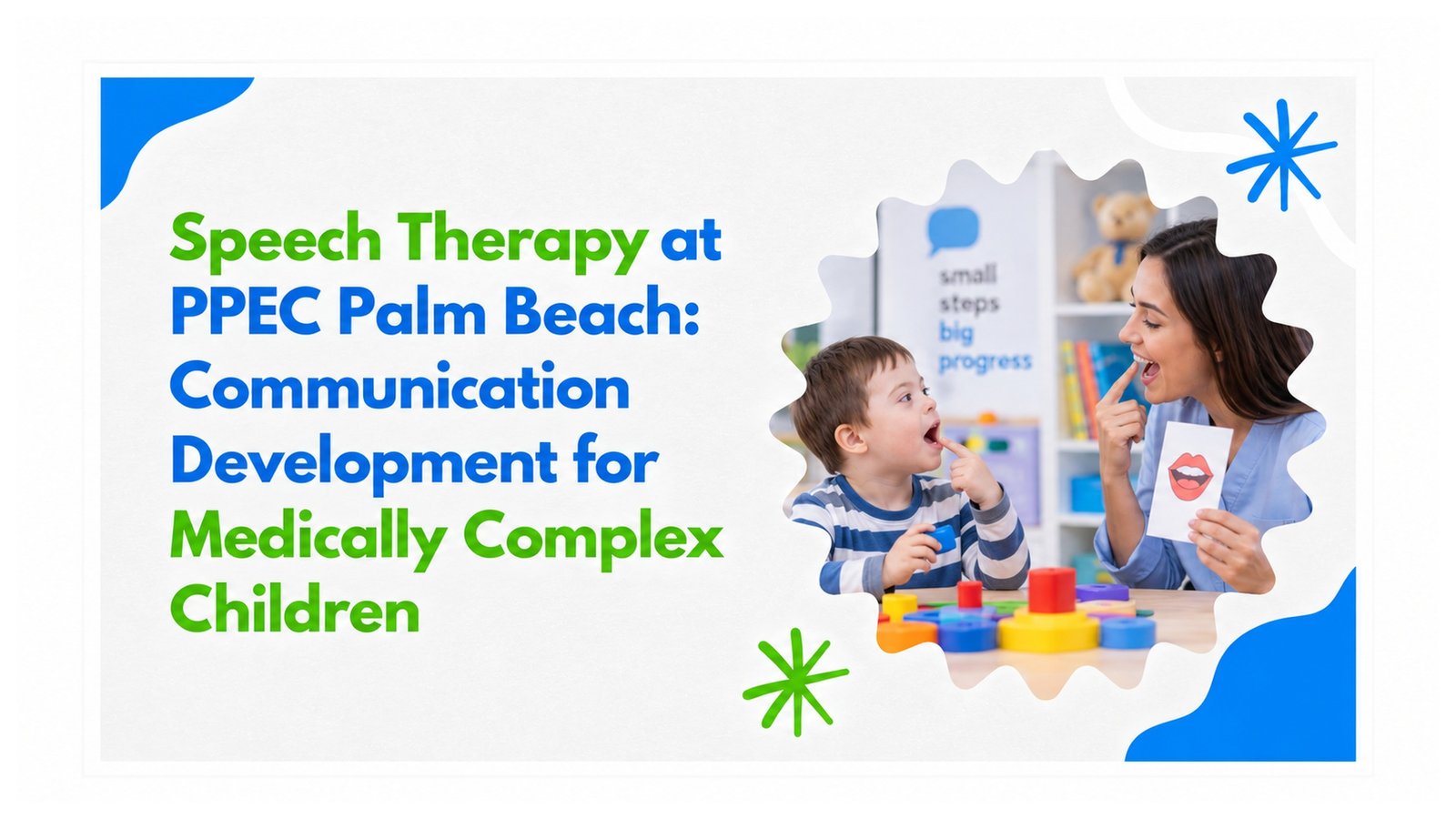
Communication is the foundation of everything a child experiences in their world. It is how they tell someone they are in pain, ask for what they need, connect with another person, and begin to understand the world around them. For children with complex medical needs, the ability to communicate, whether through words, signs, pictures, or devices, is not a developmental luxury. It is a clinical priority.
At PPEC of Palm Beach, speech-language pathologists (SLPs) are integral members of every child’s clinical care team. Our speech therapy program addresses communication support, feeding and swallowing, and the oral motor foundations that both depend on, within an integrated program designed specifically for medically fragile children.
What Is Pediatric Speech Therapy?
Pediatric speech therapy, more precisely called speech-language pathology, addresses a far broader scope than speech sounds alone. Speech-language pathologists evaluate and treat difficulties in:
- Receptive language: Understanding spoken language, following directions, and processing verbal information
- Expressive language: Using words, phrases, and sentences to communicate thoughts, needs, and ideas
- Speech clarity and articulation: Producing speech sounds accurately enough to be understood
- Social communication (pragmatics): Using language appropriately in social contexts, including turn-taking and reading social cues
- Augmentative and alternative communication (AAC): Using picture boards, speech-generating devices, or sign systems to support or replace verbal communication
- Feeding and swallowing: Addressing oral motor development, safe swallowing, and the sensory and behavioral components of eating
For children with medical complexities, communication difficulties rarely arise in isolation. Typically, delays in speech, communication, or feeding are directly related to a child’s diagnosis. Because these challenges are closely connected to a child’s overall health, speech-language pathologists work hand-in-hand with doctors, nurses, and other therapists to support the child’s progress. Within a PPEC medical daycare, this collaborative approach ensures children receive continuous medical supervision alongside speech therapy, creating a safe environment that supports both communication and overall health.
Speech Therapy and Occupational Therapy: Understanding Where They Overlap
Families often ask how speech therapy relates to occupational therapy, since both can be involved in feeding and sensory work. The two disciplines are distinct but frequently collaborative.
| Speech Therapy | Occupational Therapy | |
| Primary focus | Communication, language, feeding, swallowing | Daily living skills, fine motor function, sensory processing |
| Feeding role | Oral motor function, swallowing safety, texture progression | Adaptive utensils, mealtime positioning, feeding behavior |
| Sensory role | Oral sensory tolerance for feeding | Whole-body sensory regulation |
| Key tools | AAC devices, communication boards, oral motor tools | Splints, adaptive equipment, sensory diet strategies |
While speech and occupational therapy each address different developmental needs, many children also benefit from pediatric physical therapy to improve strength, mobility, posture, and balance. At PPEC of Palm Beach, therapists collaborate across disciplines to create coordinated treatment plans, ensuring every therapy complements the others and supports the child’s overall development.
At PPEC of Palm Beach, SLPs and occupational therapists coordinate closely, particularly around feeding goals, to ensure each discipline reinforces the other.
Children Who Benefit From Speech Therapy at PPEC
Speech therapy at PPEC of Palm Beach supports children across a wide range of diagnoses, including:
- Cerebral palsy, in which motor impairments affecting the speech mechanism disrupt articulation, voice, and feeding alongside language development
- Autism spectrum disorder, in which social communication differences, language delays, and sensory sensitivities affecting feeding are well-supported by individualized speech therapy
- Prematurity, resulting in oral motor delays, feeding difficulties, and language development that benefits from early, consistent SLP support
- Genetic and chromosomal syndromes such as Down syndrome, where language development and oral motor function benefit significantly from ongoing speech therapy
- Tracheostomy and ventilator dependence, where the tracheostomy directly affects voice and verbal communication, require SLP expertise in alternative communication and voice restoration
- Childhood apraxia of speech, a motor planning condition in which the brain has difficulty coordinating the precise movements required for speech production
- Feeding and swallowing disorders arising from oral motor dysfunction, sensory aversions, or neurological conditions affecting the swallowing mechanism
What Speech-Language Pathologists Do at PPEC
Evaluation and Goal Setting
Every child’s speech therapy program begins with a thorough evaluation covering receptive and expressive language, speech clarity, social communication, oral motor function, feeding and swallowing, and the child’s current communication methods, including any AAC systems in use. Evaluations are repeated at regular intervals to track progress and ensure therapy goals evolve alongside the child’s development. Families also receive guidance and practical strategies to support speech therapy at home, helping children reinforce newly learned communication skills in their everyday routines.
Language Development
Building language, both understanding and expression, is at the core of speech therapy for most children in the PPEC program. SLPs address language through targeted vocabulary building embedded in play and daily routines, following directions at progressively increasing complexity, building sentence length and grammatical structure, developing narrative skills, and supporting the social language that peer interaction requires. Every interaction and activity in the program day is an opportunity for language learning, and the SLP works with the full care team to ensure language-rich interactions are consistent throughout every program hour.
Augmentative and Alternative Communication (AAC)
For children who are non-verbal or have severely limited verbal communication, AAC is not a last resort. It is an evidence-based first line of intervention. Decades of research confirm that AAC promotes language development and does not inhibit speech. AAC also plays a vital role in communicating with children with special needs, helping them express their thoughts, needs, and emotions more effectively. Children with complex communication needs who use AAC often demonstrate improvements in functional communication, language, behavior, and overall quality of life.
AAC systems range from low-technology options such as picture communication boards and the Picture Exchange Communication System (PECS) to high-technology speech-generating devices that produce spoken output. At PPEC of Palm Beach, SLPs assess each child’s communication needs and motor capabilities to identify the most appropriate system, implement it with fidelity across all settings, and train families and the care team in its consistent use. The PPEC team coordinates directly with the child’s physician and relevant funding sources to support device access for families who need it
Feeding and Swallowing Therapy
Feeding therapy is one of the most clinically significant services SLPs provide within the PPEC setting. Oral feeding and speech development share the same oral motor structures, including the lips, tongue, jaw, and palate, and the same neurological pathways. Children with oral motor difficulties affecting feeding often experience impacts on speech production.
Feeding therapy at PPEC addresses:
- Oral motor development: Strengthening and coordinating the lips, tongue, and jaw for safe and efficient chewing and swallowing
- Sensory tolerance: Addressing oral sensory hypersensitivity or hyposensitivity causing food refusal, texture avoidance, or unsafe eating
- Swallowing safety: For children at risk of aspiration, the SLP assesses swallowing function and works with the physician and nursing team on texture modifications and safe feeding protocols
- Feeding tube transition: For children receiving nutrition through gastrostomy tubes, the SLP develops a gradual oral feeding progression plan in coordination with the medical team
Speech Clarity and Articulation
For children who use verbal communication, speech clarity is addressed through articulation therapy, oral motor strengthening, and motor speech intervention for children with apraxia or dysarthria. Speech clarity goals are always considered in the context of each child’s overall communication profile. For a child with severely limited verbal output, improving functional communication through AAC may take priority alongside speech sound work.
Integration Into the Full Program Day
The most powerful aspect of speech therapy at PPEC of Palm Beach is its integration into the entire program day rather than isolation within a scheduled session. The SLP communicates language targets, communication strategies, and AAC protocols to the nursing and care team, ensuring every staff member interacting with the child supports communication development throughout the day.
A child working on requesting vocabulary uses that vocabulary at snack time, during play, and during transitions, supported by every member of the team. A child using an AAC device has that device consistently present and actively modeled throughout the program day. This consistency is what accelerates communication development beyond the pace achievable in weekly outpatient visits.
Home Programs
SLPs at PPEC of Palm Beach develop individualized home programs for every family, providing communication strategies, language stimulation techniques, AAC support practices, and feeding approaches that reinforce therapy goals at home. These programs use everyday routines including meals, bath time, car rides, and play as natural communication opportunities, and are updated regularly as the child’s communication develops.
When to Seek Speech Therapy
Signs that a speech-language evaluation may be warranted include:
- Limited or absent verbal communication for the child’s age
- Difficulty understanding instructions or questions at the expected developmental level
- Feeding difficulties including food refusal, texture limitations, or coughing and choking during meals
- Unclear speech that is difficult for familiar people to understand
- Limited social communication including difficulty with eye contact, turn-taking, or responding to their name
- Regression in previously acquired communication skills
For children enrolled at PPEC of Palm Beach, speech therapy evaluation is initiated as part of the intake process. Families with concerns are encouraged to reach out to the PPEC team directly.
Conclusion
For medically complex children, communication is not a supplementary developmental goal, it is the foundation for learning, relationships, and independence. As a trusted provider of PPEC palm beach county services, PPEC of Palm Beach combines speech therapy, skilled nursing, and multidisciplinary care within a specialized pediatric day health program. This integrated approach helps children strengthen communication skills while receiving the medical and developmental support they need to thrive.
FAQs
What does a speech-language pathologist treat at PPEC?
SLPs at PPEC of Palm Beach treat receptive and expressive language delays, speech clarity and articulation disorders, childhood apraxia of speech, social communication differences, AAC assessment and implementation, and feeding and swallowing disorders. All goals are individualized to each child’s communication profile, medical needs, and daily life priorities.
What is AAC and does it stop children from developing speech?
Augmentative and alternative communication (AAC) refers to any tool that supports or replaces verbal communication, from picture boards to high-technology speech-generating devices. Decades of research confirm that AAC promotes rather than inhibits speech and language development. PPEC of Palm Beach SLPs assess each child for the most appropriate system and implement it with full team support across the program day.
How does speech therapy relate to feeding therapy?
Feeding and speech development share the same oral motor structures and neurological pathways. Children with oral motor difficulties affecting feeding often experience impacts on speech production as well. At PPEC of Palm Beach, SLPs address both domains in an integrated way, covering oral motor development, sensory tolerance, swallowing safety, and feeding tube transition alongside communication goals.
How is speech therapy at PPEC different from outpatient speech therapy?
Outpatient speech therapy delivers therapy in isolated sessions, typically once to three times per week. At PPEC of Palm Beach, speech and language goals are integrated into the full program day through every interaction, mealtime, and activity, supported by the entire care team. This consistent daily exposure to targeted communication strategies produces significantly faster development than clinic sessions alone.