
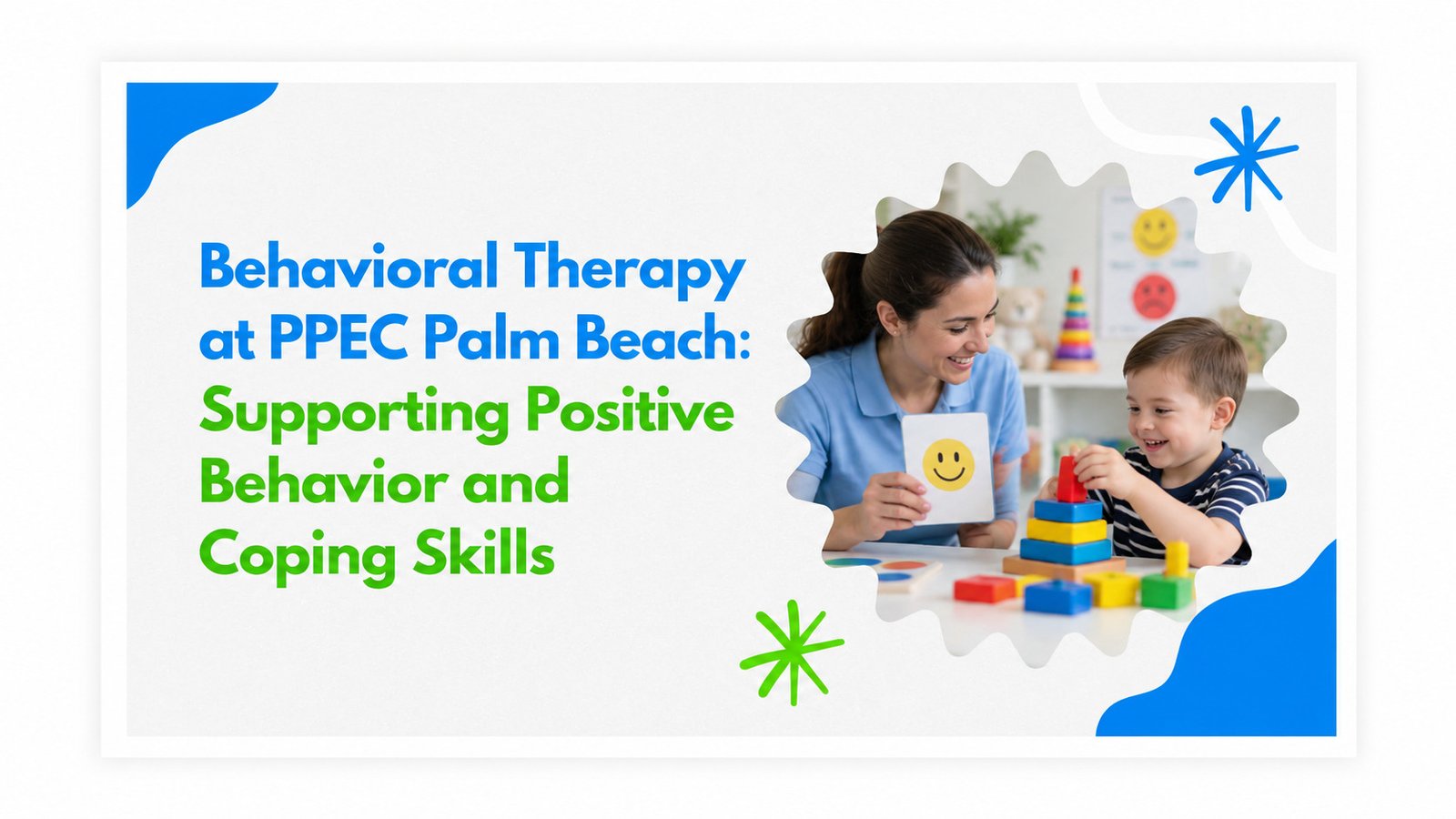
Every child communicates through behavior. A toddler who melts down at a transition is communicating that change feels overwhelming. A child who bites during a therapy session is communicating that something is too much. A school-age child who shuts down during structured activities is communicating that the demand exceeds their current capacity to cope. Behavior is not simply something to manage. It is something to understand.
For medically complex children, this understanding is especially important. The conditions that bring children to PPEC of Palm Beach, including cerebral palsy, autism spectrum disorder, genetic syndromes, prematurity, and acquired neurological conditions, frequently affect the emotional regulation, sensory tolerance, and cognitive flexibility that behavioral self-management depends on. At PPEC of Palm Beach, behavioral therapy treats behavior as communication and builds the positive skills, coping strategies, and supportive environments that allow children to thrive.
What Is Behavioral Therapy for Kids?
Behavioral therapy for children is a broad category of evidence-based clinical approaches that help children understand the connection between thoughts, feelings, and behaviors, and develop the skills to manage challenging emotions, reduce problematic behaviors, and build more effective ways of responding to daily demands.
Several frameworks guide behavioral therapy in pediatric settings:
Applied Behavior Analysis (ABA) is a data-driven approach that analyzes the relationship between environmental events and behavior, identifies the functions that behaviors serve, and uses this understanding to reduce challenging behaviors while teaching functional replacement skills. ABA is widely used and well-researched, particularly for children with autism spectrum disorder.
Positive Behavior Support (PBS) evolved from ABA with a stronger emphasis on person-centered, family-centered care. PBS modifies the environments and conditions that trigger challenging behavior and teaches new skills that give the child a more effective and appropriate way to meet the same need. Research consistently shows that PBS improves school performance, reduces aggression and self-injurious behavior, reduces meltdowns, and helps children learn to communicate their needs more effectively.
Cognitive Behavioral Therapy (CBT) for kids helps children recognize the connection between thoughts and behaviors, develop problem-solving strategies, and build coping skills for managing anxiety, frustration, and other challenging emotional states. CBT is a well-established intervention for pediatric anxiety and is adapted for children using age-appropriate techniques, including play, art, and structured activities.
At PPEC of Palm Beach, behavioral therapy draws from all of these frameworks, selecting the approaches most appropriate to each child’s developmental level, diagnosis, and behavioral profile.
Children Who Benefit From Behavioral Therapy at PPEC
Behavioral therapy at PPEC of Palm Beach supports children across a wide range of presentations, including:
- Autism spectrum disorder, in which behavioral therapy is a primary evidence-based intervention for communication development, reduction of challenging behaviors, and building of daily living and social skills
- Intellectual disabilities and developmental delays, in which behavioral support addresses challenging behaviors that commonly arise when communication or cognitive skills are limited
- Attention and impulse control difficulties, in which behavioral strategies support self-regulation, task engagement, and management of frustration
- Anxiety and emotional dysregulation, in which CBT-informed approaches build the coping skills and emotional tolerance that reduce avoidance and meltdowns.
- Feeding and medical procedure-related behavioral challenges, in which behavioral therapy addresses the distress responses that can make essential medical care and nutritional management difficult
- Transition and routine difficulties, in which structured behavioral supports ease the significant challenges that arise for many medically complex children during activity or setting changes
What Behavioral Therapists Do at PPEC
Functional Behavioral Assessment
Effective behavioral therapy begins with understanding, not assumption. At PPEC of Palm Beach, behavioral therapists conduct individualized Functional Behavioral Assessments (FBAs) that identify the specific triggers, patterns, and functions of each child’s challenging behaviors.
The FBA process includes observation across multiple settings and activities, data collection on antecedents, the behavior itself, and consequences, and interviews with families and the care team. The FBA answers the most important question in behavioral support: what is this behavior communicating, and what need is it serving? Without this understanding, interventions address symptoms rather than causes, and results are rarely durable.
Individualized Behavior Support Plans
Based on the FBA, the behavioral therapist develops an individualized Behavior Support Plan (BSP) that is positive, strengths-based, and specific to the child. PBS guidance consistently emphasizes prevention strategies, replacement skill instruction, new ways to respond to problem behavior, and ongoing monitoring as core parts of effective support plans.
The BSP includes:
- Prevention strategies: Environmental modifications and proactive supports that reduce the conditions under which challenging behavior is most likely to occur
- Replacement skill instruction: Teaching a functional, appropriate alternative behavior that serves the same communicative purpose as the challenging behavior
- Coping skill development: Building the child’s strategies for managing difficult emotions, sensory experiences, transitions, and demands
- Response protocols: How the care team responds when challenging behavior does occur, in ways that do not inadvertently reinforce it
- Positive reinforcement systems: Individualized structures that motivate and recognize behavioral progress
The BSP is implemented by every member of the PPEC care team, which is essential to its effectiveness. Positive behavior support works best when consistently applied by everyone involved with the child.
Coping Skills Development
Building an active coping skill toolkit is one of the most durable outcomes of behavioral therapy. Guidance on positive behavior and coping skill development emphasizes teaching multiple coping strategies, including at least one that the child can use in the moment, practicing those skills regularly, and embedding them in the child’s natural environment.
Coping skills taught through behavioral therapy at PPEC include regulated breathing techniques, sensory self-regulation strategies developed in coordination with the occupational therapist, visual supports such as emotion cards and first-then boards, requesting breaks as a replacement for behavioral escalation, and structured problem-solving frameworks for children with sufficient cognitive capacity.
Cognitive Behavioral Therapy Approaches
For children with sufficient cognitive and language development, CBT-informed approaches are incorporated into behavioral therapy at PPEC. These include emotion identification activities that build awareness and vocabulary for naming emotional states, graduated exposure for children whose behavioral challenges are driven by anxiety, structured relaxation techniques adapted for children at various developmental levels, and social stories that prepare children for challenging transitions or unfamiliar demands by providing a predictable cognitive framework in advance.
Behavior Therapy for Kids With Autism Spectrum Disorder
For children with autism spectrum disorder, behavioral therapy at PPEC incorporates ABA-informed approaches within the PBS framework. This includes Discrete Trial Teaching for building foundational communication and self-care skills in a structured step-by-step format, Pivotal Response Training targeting motivation and communication initiation in the child’s natural environment, visual schedules that reduce transition-related behavioral challenges by making the program day predictable, and functional communication training that systematically teaches children to communicate needs through words, signs, or AAC systems as a direct replacement for challenging behaviors driven by communication frustration.
Integration Into the Full Program Day
The effectiveness of behavioral therapy at PPEC of Palm Beach depends on its integration across the entire day. The behavioral therapist communicates prevention strategies, response protocols, reinforcement systems, and coping skill prompts to every member of the care team, ensuring that the behavioral support framework is applied consistently from morning arrival through afternoon pickup.
When a child’s BSP specifies that a visual schedule reduces transition-related meltdowns, that schedule is in place for every transition throughout the day. When a reinforcement system calls for specific praise following a target behavior, every staff member delivers it consistently. This consistent implementation across all staff and settings is what produces durable behavioral change. Behavior changes when environments change consistently, not when a single therapist applies strategies in a brief session.
Family Involvement and Home Programs
Behavioral therapy produces the strongest outcomes when families are active participants in the support plan. At PPEC of Palm Beach, the behavioral therapist provides every family with a clear explanation of FBA findings and the BSP in accessible terms, specific strategies the family can use at home to maintain consistency with the PPEC program, guidance on positive reinforcement, transition supports, and coping skill practice in the home environment, and regular updates on progress and plan adjustments as the child develops.dphhs.
Children benefit most from behavioral therapy when strategies are applied consistently across every environment they inhabit, and no environment shapes a child more than home.
When to Seek Behavioral Therapy
Signs that a behavioral therapy evaluation may be warranted include frequent meltdowns or emotional outbursts disproportionate to the triggering event, self-injurious behaviors such as head banging or biting, aggression during care routines or therapy, significant difficulty with activity transitions, persistent refusal of essential medical care or feeding, and behavioral regression following medical events or life changes.
For children enrolled at PPEC of Palm Beach, behavioral needs are assessed as part of the intake process. Families with concerns are encouraged to reach out to discuss their child’s specific situation.
Conclusion
Behavior is communication, and behavioral therapy is the clinical discipline that ensures every child has a more effective way to communicate than the challenging behaviors that emerge when coping skills, communication tools, or supportive environments are insufficient. At PPEC of Palm Beach, behavioral therapists work within an integrated care team to build the positive behavioral skills, coping strategies, and environmental supports that allow medically complex children to engage, connect, and thrive throughout every program day.
FAQs
What is the difference between ABA, PBS, and CBT for children?
Applied Behavior Analysis (ABA) is a data-driven approach that uses the understanding of behavioral functions to reduce challenging behaviors and teach replacement skills. Positive Behavior Support (PBS) evolved from ABA with a stronger person-centered focus, emphasizing environmental modification and replacement skill instruction. Cognitive Behavioral Therapy (CBT) for kids helps children recognize connections between thoughts, feelings, and behaviors, building coping strategies particularly effective for anxiety and emotional dysregulation. At PPEC of Palm Beach, behavioral therapy draws from all three frameworks based on each child’s individual needs.
Is behavioral therapy at PPEC appropriate for children with autism?
Yes. Behavioral therapy is a primary evidence-based intervention for children with autism spectrum disorder. At PPEC of Palm Beach, behavioral therapy for autistic children incorporates ABA-informed approaches within a positive behavior support framework, including discrete trial teaching, pivotal response training, functional communication training, and visual supports, all individualized to the child’s communication level, behavioral profile, and developmental priorities.
What is a Functional Behavioral Assessment and why does it matter?
A Functional Behavioral Assessment (FBA) is a structured evaluation that identifies the triggers, patterns, and functions of a child’s challenging behaviors. It answers the question of what the behavior is communicating and what need it serves. The FBA is the foundation of effective behavioral support because interventions that address the function of behavior produce far more durable outcomes than those addressing only surface presentation.
How does behavioral therapy coordinate with speech and occupational therapy at PPEC?
Behavioral challenges are frequently driven by communication limitations or sensory processing difficulties. The behavioral therapist, SLP, and OT share assessment findings, align goals, and coordinate strategies across the full day, ensuring that each discipline reinforces the others. Functional communication training is developed jointly with the SLP, and sensory regulation strategies within the behavior plan are aligned with the OT’s sensory diet.