
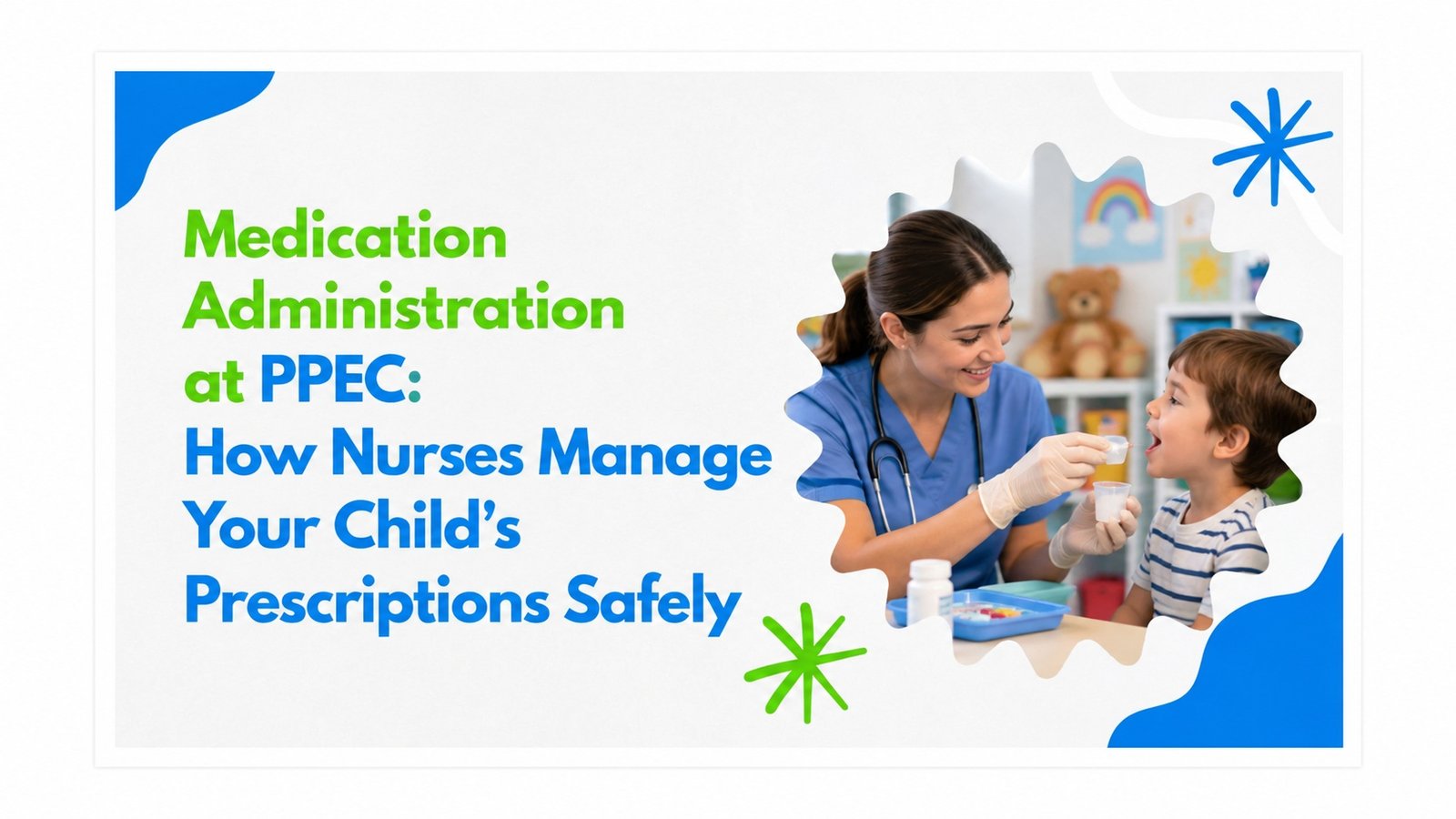
If you’re a parent of a medically complex child, you already know that medication schedules can get complicated fast. Some children enrolled in our facility take five or six different prescriptions a day, each with its own timing, dose, and route. A few need medication through a feeding tube, while others have rescue medications sitting ready in case of a seizure or a breathing emergency. When a child can’t tell you if a dose feels wrong or can’t describe a side effect, the people giving that medication have to get it right every time, not most of the time.
At PPEC of Palm Beach, our nurses understand that medication administration is one of the most serious parts of the day, not a routine task squeezed in between other activities. Every dose administered is checked thoroughly before it ever reaches a child, and that process doesn’t get skipped, even on busy days.
Why Medication Management Looks Different at PPEC
Many families ask why PPEC handles medication so differently than a school nurse’s office or a typical childcare center would. The honest answer is that our children’s needs are different in ways that raise the stakes considerably. Many of the children here have medication needs where accuracy and timing are critical. Even a small mistake, such as a missed dose, a delayed one, or a dose that no longer fits the child’s needs, can carry real health consequences, which raises the stakes well beyond a typical setting.
Much of this approach is based on communication. Many of the children we care for are unable to manage their medication schedule on their own. A child that is nonverbal, too young, or medically fragile may not be able to communicate if it’s time to administer the next dose of medication, or explicitly state that they are feeling side effects of a medication, so it’s incredibly important that nurses remain vigilant to catch mistakes before they occur. Licensed nurses at PPEC of Palm Beach are specifically trained to be responsible for medication administration and monitoring thereafter for this purpose.
Who Administers Medication at PPEC
Every medication at PPEC, whether it’s a routine daily pill or an emergency rescue dose, is given by a registered nurse or an LPN working under RN supervision. Our nurses are trained specifically in pediatric dosing, including routes that aren’t always simple. Gastrostomy tube medications, nebulized breathing treatments, rectal or intranasal rescue medications used during a seizure, and injectable medications that require precise, weight-based dosing are all methods that our nursing team are familiar with.
Nurses are trained to know each child by sight and verify a medication by name and dose before administering anything. It sounds like a small detail, but with children who look similar in age or size, it’s exactly the kind of check that prevents a wrong-child error.
The Verification Process Behind Every Dose
Nursing schools teach a set of checks known as the “rights” of medication administration, and this remains the backbone of how doses are verified today. At PPEC, our nurses run through these checks for every single dose, not just the tricky ones. Before medication ever reaches a child, a nurse confirms:
- The right child, checked against the chart rather than by name alone
- The right medication, with the label matched against the physician’s order
- The right dose, cross-checked with the child’s current weight
- The right route, whether oral, tube-fed, inhaled, or another delivery method
- The right time, within the window specified by the physician
Once the dose is given, it gets logged immediately, with the time and the administering nurse’s name attached. What makes this process reliable isn’t a single check. The label gets verified when the medication is pulled from storage, verified again while it’s being prepared, and verified one final time right before it’s given. For higher-risk medications, such as insulin or a rescue anticoagulant, a second nurse independently confirms the child and the dose before administration
Keeping Medication Lists Accurate and Current
A child’s prescriptions rarely stay the same for long. Doses get adjusted as kids grow, new medications get added after a specialist visit, and old ones get dropped when a treatment plan changes. Our nurses keep each child’s medication list current in the medical record and review it on a regular schedule, not just when a new order comes in.
Sometimes that review turns up something worth a second look, such as a dose that no longer matches the child’s weight, or a medication order that appears to be missing an update. When this happens, the nurse flags it directly with the child’s physician and parent rather than assuming it will resolve on its own. This habit catches problems that could otherwise slip through the cracks between doctor visits.
Coordinating Medication With the Rest of the Day
Giving a dose on time is only part of the job. A seizure medication known to cause drowsiness is timed around therapy sessions rather than right before one. A tube-fed medication is coordinated with the child’s feeding schedule. A rescue medication plan for seizures is shared with every staff member on the floor, not only the child’s assigned nurse, because a seizure doesn’t wait for the right nurse to walk by.
This kind of coordination requires nurses to stay in constant contact with physicians, therapists, and parents. When a doctor changes a prescription, that update needs to be reflected in the record before the next scheduled dose, not after. When a parent mentions a new side effect noticed over the weekend, that information gets passed along and factored into how the child is monitored during the day.
Handling Emergency and Rescue Medications
Not every medication PPEC nurses manage follows a fixed schedule. Rescue medications for a seizure cluster, or an emergency inhaler for sudden respiratory distress, are used only when specific symptoms appear, and they need to be given quickly.
For these situations, nurses follow an action plan written by the child’s physician that spells out exactly which symptoms call for the medication, how much to give, and what comes next if the first dose doesn’t work. These medications are kept somewhere secure but easy to reach quickly. Every nurse and aide working with the child on shift, not only the one assigned to that child, is trained to recognize when a child’s plan calls for action.
Communication With Families and Pharmacies
PPEC nurses talk with families about medication changes, side effects noticed during the day, and updates recommended by the physician. When a new prescription starts, or an existing one changes, our team may work directly with the pharmacy to confirm that what arrives at the center matches the doctor’s order exactly, down to the strength and formulation.
This communication runs both ways. If your child’s medication changes after an outside appointment or you notice something new at home, please let the nursing team know. That kind of back-and-forth is often what keeps a child’s care consistent across the different places they spend their day.
Why Precision Matters So Much Here
For a medically fragile child, a medication mistake carries more weight t. A missed anticoagulant dose can bring on a seizure. An incorrect cardiac medication dose can affect heart rhythm. A delayed rescue medication during a respiratory event can escalate quickly. This is why our process is built with redundancy on purpose. It moves slower than it might need to for a low-risk situation, but it’s designed for the situations that aren’t low-risk.
Families trust PPEC with some of the most sensitive parts of their child’s daily care, and medication sits at the center of that trust. Every scheduled dose, every as-needed medication, and every rescue protocol is treated with the same level of attention.
Conclusion
Medication administration is one of the most important responsibilities carried out at PPEC each day, and it takes more than good intentions to get it right. It requires trained nurses, a process that takes no shortcuts, and constant communication among everyone involved in a child’s care. If you have questions about how our nursing team manages your child’s medication, or want to learn more about our process, reach out to the PPEC Palm Beach team today.
FAQs
Who gives my child their medication at PPEC?
Only registered nurses or LPNs working under RN supervision administer medication at PPEC of Palm Beach. Aides and general caregivers do not give medication. Our nurses are trained in pediatric dosing, non-oral routes such as feeding tubes and nebulizers, and emergency rescue protocols.
How does PPEC avoid medication errors?
Nurses confirm the child, medication, dose, route, and timing before each dose, and the label is verified multiple times along the way. For higher-risk medications, a second nurse independently checks everything before it is given.
What happens if my child has a seizure and needs rescue medication?
Rescue medications follow an action plan written by your child’s physician, spelling out the exact symptoms that call for the medication, the correct dose, and the next steps if it doesn’t work right away. Every nurse and aide on shift knows the plan, not only your child’s assigned nurse to ensure rapid response. .
How does PPEC stay on top of medication changes from my child’s doctor?
Nurses keep a current medication list for each child and review it on a regular schedule, not only when a new medication is added. If a physician changes a prescription, the record is updated, and the team confirms with the pharmacy that the medication that arrives matches the order exactly.
What should I tell PPEC nurses about my child’s medication?
Tell them about anything that changes. If your child’s doctor adjusted a dose, if you noticed a side effect at home, or if something simply seems off, let the nursing team know. This ongoing communication is a significant part of what keeps your child’s care consistent.