
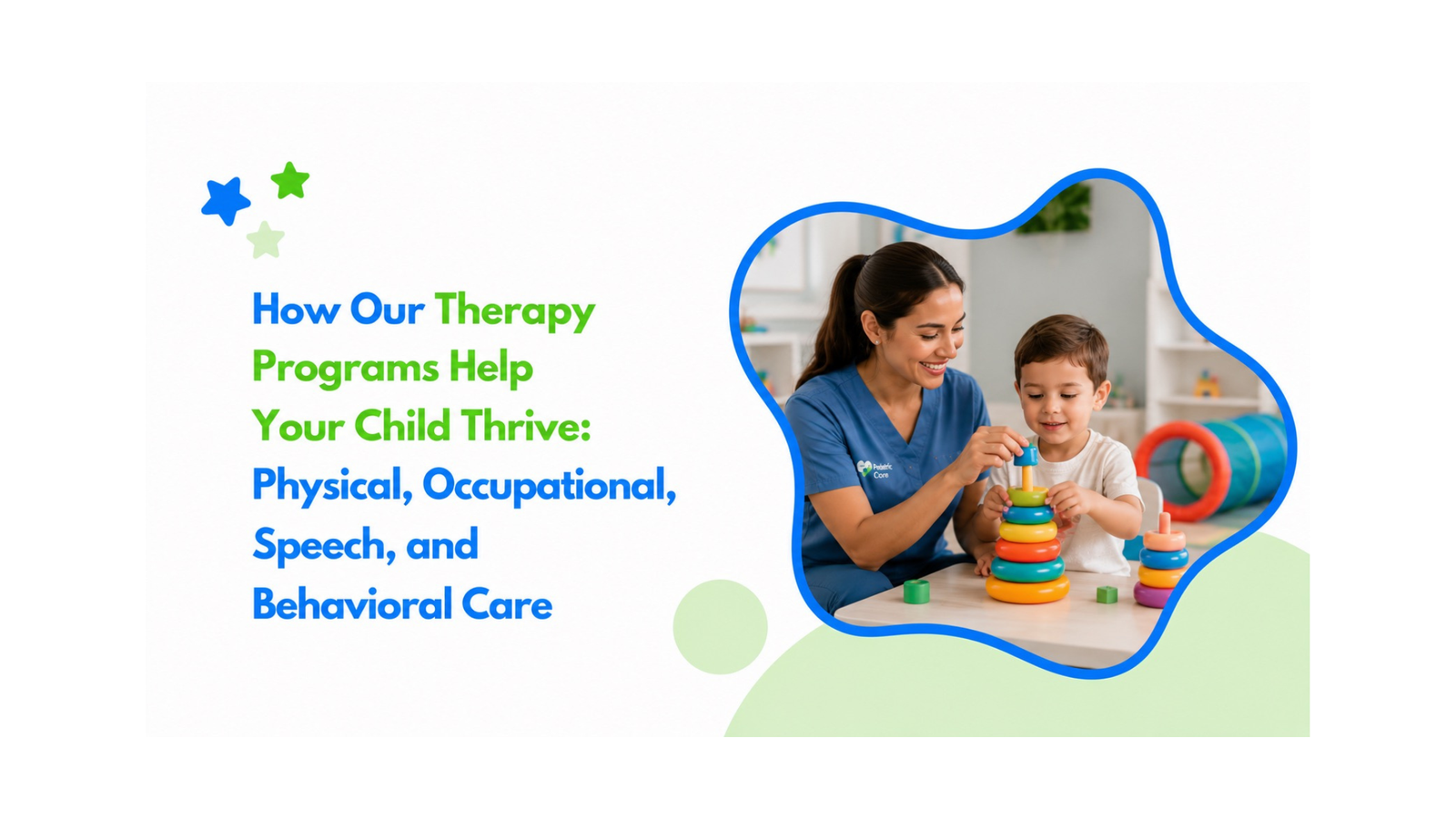
Every parent wants to see their child thrive. Not just survive the day, get through the medical routines and the appointments and the challenges that complex needs bring, but genuinely flourish. To learn something new, communicate something meaningful, move more freely, or simply experience the confidence that comes from mastering a skill that once felt out of reach.
At PPEC of Palm Beach, therapy is not a supplementary service added onto medical care. It is woven into every hour of your child’s day, delivered by specialists who understand medical complexity, coordinated with the nursing team managing your child’s clinical needs, and designed around each child’s unique developmental profile. Here is how each of our therapy programs works, what it addresses, and why their integration produces outcomes that isolated, appointment-based therapy simply cannot match.
Why Integrated Therapy Changes Everything
Before exploring each therapy discipline individually, it’s worth understanding why integration matters so much for children with medical complexities or developmental delays.
When therapy happens in separate outpatient appointments- physical therapy on Monday, speech therapy on Wednesday, and occupational therapy on Friday- three things are true. Each therapist makes decisions without being fully aware of what the others are working on. Skills practiced during a 45-minute session are rarely reinforced during the rest of the child’s day. Additionally, families carry the exhausting burden of scheduling, transporting, and coordinating between multiple providers who may never communicate directly.
In an integrated therapy model, therapists share documentation, align on goals, and reinforce each other’s work between sessions and throughout the child’s entire day. A communication strategy introduced in speech therapy is used consistently by every staff member during activities. A fine motor goal from occupational therapy is reinforced during art projects and mealtimes. A physical therapy positioning goal is maintained throughout the day, not just during a session.
This coordination is what accelerates progress. And at PPEC of Palm Beach, it is how our child therapy services operate every single day.
Physical Therapy: Building the Foundation for Movement and Independence
Pediatric physical therapy focuses on the gross motor skills that allow children to move through and interact with the world, including strength, coordination, balance, posture, and mobility. For medically complex children, these foundations are often affected by the underlying conditions themselves: a child with cerebral palsy has movement patterns shaped by neurological differences; a premature infant may have delayed motor development across multiple areas; a child with a genetic syndrome may have low muscle tone that affects everything from sitting to walking.
What It Addresses
Physical therapists at PPEC of Palm Beach assess each child’s individual motor profile and design intervention plans that address:
- Postural control and core strength, which form the foundation for all other motor skills, directly affect respiratory function in children with breathing difficulties.
- Gross motor milestone development, including rolling, sitting, standing, and walking, progressed at a pace appropriate to each child’s medical and developmental reality.
- Balance and coordination, building the stability that allows children to participate in play, self-care, and social activities.
- Mobility and positioning, including the use of adaptive equipment such as standers, gait trainers, or wheelchairs that maximize a child’s independence and participation.
- Therapeutic exercise, building strength and endurance within the safe physiological parameters established in coordination with the nursing team.
How It’s Delivered at PPEC
Physical therapy goals don’t live only in therapy sessions; they live in how a child is positioned throughout the day, how transitions between activities are managed, and how movement opportunities are built into daily programming. Our physical therapists work directly with nursing staff to ensure that therapeutic positioning and movement goals are maintained across the entire program day, not just during scheduled sessions.
Occupational Therapy: Building Independence in Daily Life
What It Addresses
Occupational therapy for children addresses the skills children need to participate in the daily activities, or “occupations”, of childhood: playing, eating, dressing, learning, and interacting with the world around them. For medically complex children, these everyday activities can present genuine challenges rooted in sensory processing differences, fine motor delays, or difficulty with the sequencing and self-regulation required for daily tasks.
Our occupational therapists address:
- Postural control and core strength, which form the foundation for all other motor skills, directly affect respiratory function in children with breathing difficulties.
- Gross motor milestone development, including rolling, sitting, standing, and walking, progressed at a pace appropriate to each child’s medical and developmental reality.
- Balance and coordination, building the stability that allows children to participate in play, self-care, and social activities.
- Mobility and positioning, including the use of adaptive equipment such as standers, gait trainers, or wheelchairs that maximize a child’s independence and participation.
- Therapeutic exercise, building strength and endurance within the safe physiological parameters established in coordination with the nursing team.
How It’s Delivered at PPEC
Physical therapy goals don’t live only in therapy sessions; they live in how a child is positioned throughout the day, how transitions between activities are managed, and how movement opportunities are built into daily programming. Our physical therapists work directly with nursing staff to ensure that therapeutic positioning and movement goals are maintained across the entire program day, not just during scheduled sessions.
Occupational Therapy: Building Independence in Daily Life
What It Addresses
Occupational therapy for children addresses the skills children need to participate in the daily activities, or “occupations”, of childhood: playing, eating, dressing, learning, and interacting with the world around them. For medically complex children, these everyday activities can present genuine challenges rooted in sensory processing differences, fine motor delays, or difficulty with the sequencing and self-regulation required for daily tasks.
Our occupational therapists address:
- Sensory processing, helping children who are overwhelmed by sensory input, sounds, textures, movement, or touch develop the regulation strategies that allow them to engage more fully in learning and social environments.
- Fine motor development, building the hand strength, dexterity, and coordination required for self-feeding, grasping toys, and early pre-writing skills.
- Self-care and daily living skills, including feeding, dressing, and hygiene, are broken into manageable steps and practiced with consistent strategies that build toward independence.
- Play skills, developing the purposeful, flexible play that allows children to learn from their environment and interact meaningfully with peers.
- Self-regulation and emotional management, building the coping strategies that help children manage transitions, frustration, and unexpected changes without significant behavioral distress.
How It’s Delivered at PPEC
Sensory strategies recommended by our occupational therapists are incorporated into daily programming, morning activities, mealtimes, transitions, and rest periods. This ensures continuous regulation support rather than limiting it to therapy sessions. Fine motor goals are reinforced through art projects, play activities, and self-care routines that happen naturally throughout the day.
Speech Therapy: Building Communication and Feeding Safety
What It Addresses
Speech therapy for kids extends far beyond articulation. For children in the PPEC population, speech and language therapy addresses the full spectrum of communication, verbal and nonverbal, expressive and receptive, functional and social, alongside the feeding and swallowing difficulties that many medically complex children experience.
Our speech-language pathologists address:
- Functional communication, giving every child a reliable way to express needs, wants, and feelings, whether through spoken language, picture exchange systems, sign language, or Augmentative and Alternative Communication (AAC) devices.
- Receptive language, building comprehension of spoken language, instructions, and social cues, is a process that many children with medical complexity struggle to process.
- Expressive language, developing vocabulary, sentence structure, and the ability to share ideas and experiences with others.
- Social and pragmatic language, addressing the conversational skills, turn-taking, topic maintenance, and reading facial expressions that underpin meaningful social connections.
- Feeding and swallowing, working with children who have oral motor difficulties, sensory sensitivities around food, or aspiration risks, to build safer, more varied, and more enjoyable eating experiences.
- AAC implementation, supporting children who use communication devices or systems to ensure these tools are used effectively and consistently across all settings.
How It’s Delivered at PPEC
Communication goals are never confined to therapy sessions. The strategies and systems our speech therapists establish are used consistently by every member of the care team, nurses, developmental program staff, and therapists across all disciplines, throughout the entire day. For children using AAC devices, those devices are present and actively facilitated during all activities, not just during speech therapy time.
Behavioral Therapy: Building Skills for Engagement and Daily Life
What It Addresses
Behavioral therapy for children, particularly Applied Behavior Analysis (ABA) and related behavioral intervention approaches, addresses the functional behaviors that affect a child’s ability to learn, communicate, and participate in daily life. For children with behavioral differences, like autism spectrum disorder, behavioral intervention is an evidence-based cornerstone of their developmental support. For children with other conditions, behavioral strategies support self-regulation, adaptive behavior, and the reduction of behaviors that interfere with learning and social engagement.
Behavioral support at PPEC addresses:
- Communication and language, using behavioral principles to systematically build functional communication in children who have not developed reliable verbal or nonverbal communication.
- Social skills, developing the interaction patterns, play skills, and peer engagement that allow children to form connections with others.
- Adaptive behavior, building the daily living skills, toileting, self-feeding, dressing, following routines, that support growing independence.
- Reduction of challenging behaviors, understanding the function of behaviors that interfere with learning or safety, and replacing them with functional alternatives.
- Learning readiness, building the attention, imitation, and instruction-following skills that allow children to benefit from educational and therapeutic programming.
How It’s Delivered at PPEC
Behavioral strategies are most effective when applied consistently across all environments and interactions. At PPEC of Palm Beach, we welcome Registered Behavioral Technicians (RBTs) to work with children throughout the day. Behavioral approaches are also embedded in daily routines, including how staff respond to communication attempts, how transitions are managed, and how activities are structured to support attention and engagement. This consistency across the entire program day is what allows behavioral strategies to generalize into your child’s life at home and in the community.
The Power of All Four Working Together
The most significant developmental progress for children with complex needs occurs when all four therapy disciplines are coordinated, with physical, occupational, speech, and behavioral goals aligned and reinforced by everyone involved in a child’s day.
Consider a child working toward independent self-feeding. Physical therapy builds the postural stability and arm strength required to bring a spoon to their mouth. Occupational therapy addresses the fine motor coordination and sensory tolerance around food textures. Speech and feeding therapy address oral motor skills and swallowing safety to enable eating. Behavioral strategies reinforce the communication of hunger and fullness, reduce mealtime distress, and build a consistent routine that allows new feeding skills to become habits.
This is not a hypothetical example; it is the daily reality of integrated therapy at PPEC of Palm Beach. When every member of the care team is working from the same goals, in the same direction, with the same strategies, children make progress that isolated weekly sessions in separate outpatient clinics cannot produce.
What Families Can Expect
When your child receives integrated child therapy services at PPEC of Palm Beach, you can expect:
- Individualized goals developed through assessment and collaboration with your family and your child’s medical team, not generic developmental targets applied to every child.
- Regular progress updates that document your child’s developmental achievements and communicate what you can do at home to reinforce the work happening during daytime hours.
- Family education from each therapy discipline, giving you the strategies and understanding to extend your child’s progress into daily life at home.
- Coordination with outside providers, including your child’s specialists and, when your child is transitioning toward school, collaboration with school-based therapy teams.
Your role in your child’s therapy progress is not passive. The more you understand what each therapist is working on and why, the more effectively you can reinforce those goals in the hours your child spends with you.
Conclusion
Children with complex medical needs deserve care that addresses every dimension of who they are, not just their clinical stability but their ability to move, communicate, connect, and participate in a childhood that is as full and as joyful as possible. At PPEC of Palm Beach, our integrated physical, occupational, speech, and behavioral therapy programs are built around exactly that belief.
If your child has medical complexity and you’re looking for a program that makes both safety and development possible every single day, we’d love to talk. Reach out to PPEC of Palm Beach to learn more about our therapy programs, our integrated care model, and how we can support your child’s journey toward their fullest potential.
FAQs
What child therapy services does PPEC of Palm Beach offer?
PPEC of Palm Beach provides integrated physical, occupational, speech, feeding, and behavioral therapy as part of daily programming. All therapy services are coordinated with the nursing team and embedded into the child’s entire day, not delivered as isolated sessions. This integrated model ensures that therapy goals are reinforced continuously, producing faster and more durable developmental progress than appointment-based therapy alone.
How does occupational therapy for children help medically complex kids?
Occupational therapy addresses sensory processing, fine motor development, self-care skills, play skills, and self-regulation, the foundational abilities that allow children to participate in learning and daily life. For medically complex children, occupational therapy is particularly important because sensory processing differences and fine motor delays often directly affect medical management, feeding, and the ability to engage in developmental programming. At PPEC, OT strategies are reinforced throughout the program day by all staff.
What does speech therapy for kids include at PPEC?
Speech therapy at PPEC addresses functional communication, receptive and expressive language, social and pragmatic language, AAC implementation, and feeding and swallowing. For many children in the PPEC population, communication and feeding are closely connected clinical priorities. Speech-language pathologists coordinate directly with nursing staff to ensure that feeding therapy occurs within a medically safe framework and that communication goals are reinforced throughout every activity and interaction on the day.
Is behavioral therapy for children covered by Medicaid at PPEC?
Behavioral therapy services provided as part of a PPEC program are covered by Medicaid for eligible children when medically necessary and prescribed by a physician. Families should verify their child’s specific coverage with the PPEC of Palm Beach enrollment team, who can assist with prior authorization and documentation. The enrollment team is experienced in navigating Medicaid coverage across all therapy disciplines and can clarify exactly what is included in your child’s authorization.
How do I know which therapies my child needs?
Your child’s pediatrician or specialist can recommend appropriate therapy evaluations based on your child’s diagnoses and developmental profile. At PPEC of Palm Beach, each enrolled child receives a thorough assessment across therapy disciplines before programming begins, identifying individualized goals across physical, occupational, speech, and behavioral domains. This assessment process ensures that your child’s therapy program reflects their actual needs rather than a generic curriculum.