
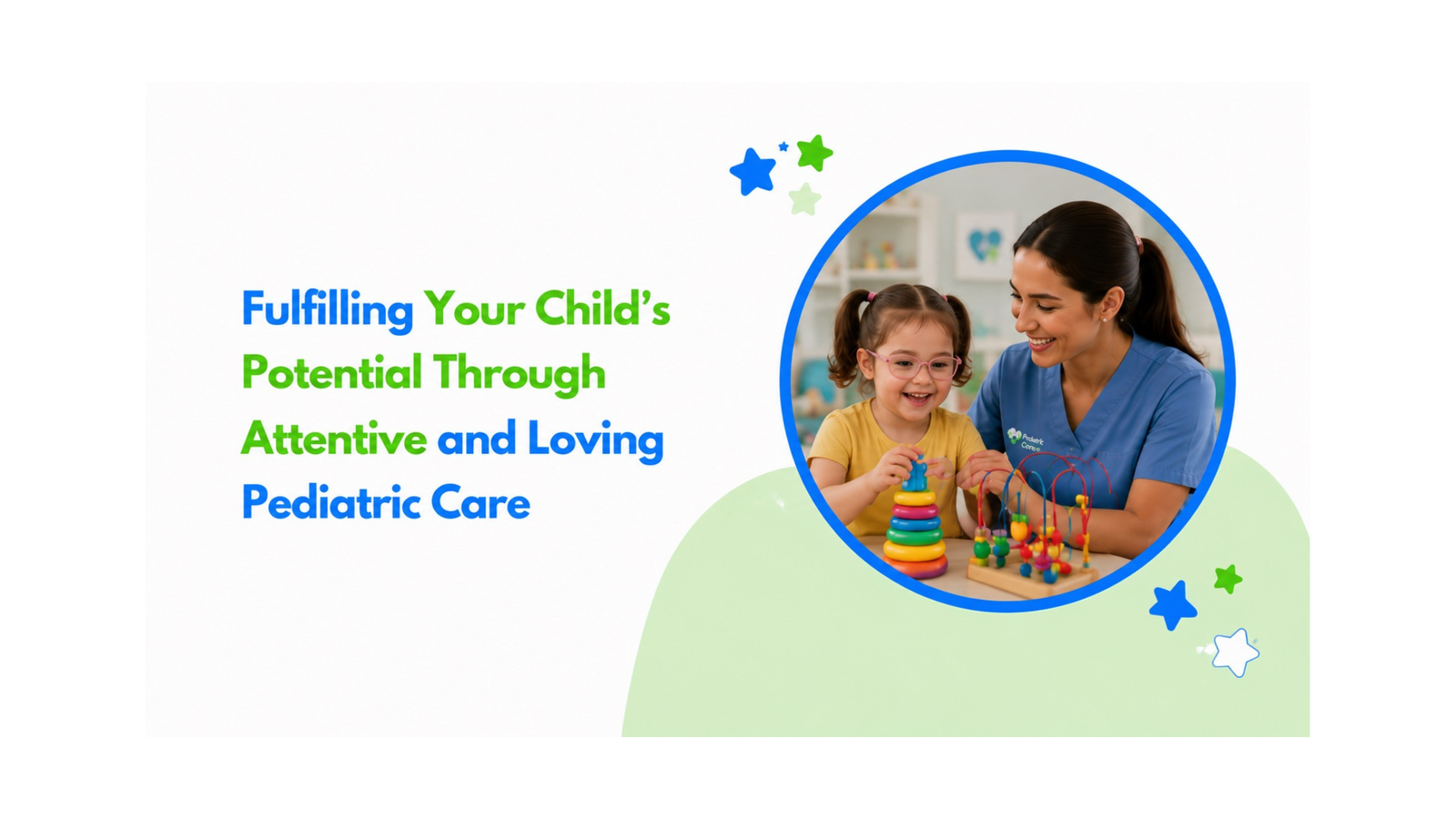
There is a version of your child’s future that lives in the back of your mind, not the idealized version that existed before the diagnosis, but the real one. The one where your child communicates something they need. Where they reach for a toy and grasp it. Where they laugh at something that surprised them. Where they are genuinely known by the people who care for them every day.
That version of your child’s future is not a fantasy, but rather something that can be made possible through attentive, loving, clinical care. This does not overlook your child’s medical complexities, but rather refuses to let these challenges define the ceiling of what your child can become.
At PPEC of Palm Beach, we believe that every child, regardless of their medical needs, has potential worth pursuing with everything we have. Here is what that belief looks like in practice, and why the combination of expert clinical care and genuine human warmth is the most powerful developmental force a medically complex child can experience.
What “Attentive and Loving” Means in a Clinical Setting
The phrase sounds simple. In practice, it takes a dedicated team to sustain. Each employee who joins our team prioritizes a “person-first” approach, meaning that they know someone’s condition or disability is only one part of who they are. They quickly familiarize themselves with their personalities, communication styles, and their clinical baselines.
Attentive care, in a clinical sense, means:
- Noticing the subtle changes in a child’s presentation before they may be indicated from a test or other monitoring system.
- Recognizing that the child who is unusually quiet this morning may be uncomfortable, not just tired
- Knowing which activity a particular child lights up for, and making sure that activity happens even on a difficult medical day.
- Tracking developmental progress with the same precision applied to clinical indicators, because both matter equally.
Loving care, in a professional setting, means:
- Speaking to children with warmth and genuine delight in who they are, not just what they need.
- Celebrating milestones, however small they appear to an outside observer, with the enthusiasm they deserve.
- Treating every family as a partner whose knowledge of their child is irreplaceable, not a visitor to be managed.
- Showing up consistently, day after day, in a way that builds the trust that medically complex children need to feel safe enough to grow.
These qualities cannot be mandated in a staff handbook. They emerge from a program culture that genuinely believes every child in its care is extraordinary and that supporting them is a privilege.
The Role of Attentive Care in Medical Outcomes
Loving care is not soft; it is clinically consequential. Research in pediatric medicine consistently demonstrates that children who feel safe, secure, and connected with their caregivers show better physiological regulation, stronger immune function, reduced stress hormone levels, and faster developmental progress than those whose care is technically competent but relationally thin.
For medically complex children, this connection is particularly significant. A child who trusts the nurses and therapists around them tolerates medical procedures with less distress. A child who feels genuinely seen and celebrated engages more fully in therapy activities. A child whose caregivers know their individual personality, preferences, and communication style receives more responsive, effective care than one who is managed solely by protocol.
Attentive, loving pediatric care is not the opposite of clinical excellence; it is what clinical excellence looks like when it is fully realized.
How PPEC of Palm Beach Pursues Individualized Care That Starts With Knowing Your Child
At PPEC of Palm Beach, care planning begins before your child’s first day. A thorough assessment covers not just diagnoses, medications, and equipment needs, but your child’s personality, preferences, communication style, and the details that make them uniquely themselves.
What soothes them when they’re distressed? What makes them laugh? What activity do they consistently seek out? What does their version of concentration look like, and what does their version of overstimulation look like?
These questions matter clinically. A care team that knows the answers to these questions can distinguish a child who is medically unwell from one who is simply having a difficult morning. They can calibrate activities and interactions to each child’s needs throughout the day. They can build an individualized relationship that allows a child to feel genuinely safe, a precondition for every form of developmental progress.
Medical Stability as the Platform for Growth
Pediatric care services at PPEC of Palm Beach are built on a foundational understanding: medical stability is not the only goal. It is the platform from which the real goals- development, communication, connection, and joy become possible.
This means that skilled nursing oversight, continuous monitoring, medication management, and equipment care are not the endpoint of what PPEC provides. They are the foundation that makes everything else possible. A child whose oxygen saturation is well-managed, whose medications are given on schedule, and whose equipment is functioning correctly is a child whose nervous system is available for learning, play, and social engagement.
The clinical infrastructure at PPEC exists in service of the child’s developmental life, not alongside it.
Integrated Therapy That Meets Children Where They Are
Fulfilling a medically complex child’s potential requires therapy that is individualized, consistent, and embedded in the child’s natural contexts throughout the day. PPEC of Palm Beach integrates physical, occupational, speech, feeding, and behavioral therapy into daily programming, with therapists who understand each child’s medical reality and design interventions that work within it, not around it.
For a child with limited mobility, physical therapy doesn’t wait for a perfect moment; it finds the therapeutic opportunity within the activity the child is already engaged in. For a child developing communication, every interaction throughout the day becomes an opportunity to practice and reinforce the strategies the speech therapist has established. For a child working on sensory regulation, every staff member uses the occupational therapist’s strategies in every setting throughout the entire program day.
This approach accelerates progress by recognizing that children learn everywhere, not just during scheduled therapy sessions.
Celebrating Every Milestone, Without Exception
One of the most important things a pediatric care team can do for a medically complex child is witness their achievements with genuine celebration. In a world that is often focused on what a child cannot yet do, a care team that marks every milestone, however incremental, with real enthusiasm sends a powerful message: You are making progress. You are capable. You are seen.
At PPEC of Palm Beach, milestones are celebrated not because they meet a standardized benchmark, but because they represent effort, persistence, and growth that are specific to that child’s journey. A child who communicates a want for the first time after months of work deserves the same celebration as a child who takes a first step. The magnitude of the effort is what matters, and our team understands that.
Family Partnership That Extends Care Into Every Part of Life
A child’s potential cannot be fully realized within program hours alone. The hours at home, the mornings, the evenings, the weekends, are where learned skills are practiced in real life, where relationships are deepened, and where the emotional security that supports development is built.
PPEC of Palm Beach’s relationship with families is designed to make those hours as rich and supported as possible. Daily reports don’t just summarize the day; they share specific observations, developmental progress, and therapy strategies that families can use at home. Regular communication with families ensures that the home and program environments reinforce one another. Parent education from the clinical team and each therapy discipline gives families the knowledge and confidence to be active participants in their child’s developmental journey.
The goal is a child whose entire day, from the moment they arrive at PPEC to the moment they fall asleep at home, is filled with relationships, experiences, and interactions that move them toward their potential.
What Potential Looks Like for Every Child
Potential is not a fixed destination; it is a direction. For every medically complex child, the direction is forward: toward more communication, more independence, more connection, more capability than they had yesterday.
For one child, potential means learning to express a preference using an AAC device after months of having preferences guessed at. For another, it means tolerating a food texture that previously caused significant distress. For another, it means sitting independently long enough to engage in a play activity with a peer. For another, it means a seizure caught early, because a nurse recognized the pre-ictal pattern and responded before the event became serious.
Though these moments may not look dramatic from the outside, every one of them is extraordinary.
Pediatric care services that pursue these moments with attentiveness, clinical precision, and genuine love are the care services that change trajectories. They are what PPEC of Palm Beach is built to provide, for every child, every day.
Conclusion
Your child’s potential is real. It is waiting for the right environment, the right team, and the right combination of clinical expertise and human warmth to draw it forward. At PPEC of Palm Beach, we bring it all: skilled nursing, integrated therapy, individualized developmental programming, and a care culture that sees every child as a whole person, worth knowing deeply.
If you are looking for pediatric care in Palm Beach that goes beyond managing your child’s medical needs, care that actively pursues who your child can become, we invite you to reach out. Let us show you what attentive, loving, and clinically excellent pediatric care looks like in practice.
FAQs
What pediatric care services does PPEC of Palm Beach provide?
PPEC of Palm Beach provides comprehensive pediatric care services, including continuous skilled nursing oversight, integrated physical, occupational, speech, and feeding, and behavioral therapy, individualized developmental programming, care coordination and family support, daily communication with families, and assistance with Medicaid enrollment and authorization. All services are coordinated within one program, covered by Medicaid for eligible medically complex children.
How does PPEC of Palm Beach support the development of medically complex children?
PPEC of Palm Beach supports development by integrating therapy and enrichment directly into daily programming, reinforcing developmental goals across all activities and interactions throughout the day, and building individualized care plans that address each child’s unique profile across medical, developmental, communication, and behavioral domains. Medical stability is seen as the platform from which developmental progress becomes possible, not as the program’s end goal.
What makes PPEC of Palm Beach different from other pediatric care programs?
PPEC of Palm Beach combines clinical excellence with a genuine relationship-centered care culture. Every child is an individual, with their own personality, preferences, and communication style, as well as a medical patient. This integration of attentive human care with skilled nursing and therapy expertise produces outcomes that clinically competent but relationally thin programs cannot replicate. Families are treated as genuine partners in their child’s care, with daily communication and active family education built into the program.
How does pediatric therapy at PPEC help children reach their potential?
Pediatric therapy at PPEC is individualized, coordinated across disciplines, and embedded in the child’s entire day rather than delivered in isolated sessions outside of a PPEC environment. Physical, occupational, speech, and behavioral therapists share goals and documentation, reinforce each other’s work, and coordinate directly with nursing staff to ensure that therapy happens within each child’s medical reality. This integration accelerates progress because skills are practiced in natural, meaningful contexts throughout the day, not just during scheduled therapy time.
How do I find out if my child qualifies for PPEC of Palm Beach?
Contact PPEC of Palm Beach directly to discuss your child’s medical needs and eligibility. Enrollment requires a physician’s prescription documenting medical necessity and Medicaid eligibility. The PPEC of Palm Beach enrollment team guides families through every step of the process, from initial eligibility assessment through Medicaid verification, prior authorization, and individualized care plan development, so that the path to enrollment is as clear and supported as possible.