
There’s a common assumption that physical therapy for cerebral palsy is about closing the gap between where a child is and where a milestone chart says they should be. It isn’t. Good therapy starts from a different question: how does this child move best, and how do we build the strength and flexibility to support it? Because no two children with cerebral palsy move the same way, the answer is always specific to the child in front of you. Progress may look different from what a milestone chart suggests, and that’s exactly the point. Physical therapy is about finding the most effective, functional way for that particular child to move, and building on it consistently.
At PPEC of Palm Beach, physical therapy is woven into each child’s care plan from day one, not brought in as an occasional add-on. Every child’s physical therapy plan reflects their specific diagnosis, current mobility, and the goals that matter most to their family, all within a setting where therapy, nursing care, and daily routine work together rather than in separate silos.
Understanding Cerebral Palsy and Movement
Cerebral palsy is a group of conditions affecting movement and posture, caused by a disruption to brain development that happens before, during, or shortly after birth. Because the condition affects the brain’s ability to coordinate muscle movement, children with cerebral palsy can experience spasticity, weakness, involuntary movements, or difficulty with balance and coordination, depending on which areas of the brain are affected.
No two children with cerebral palsy move the same way. Some walk independently with a slightly different gait, while others need a walker or wheelchair for some or all of their mobility. Some have only -partial body involvement, while others experience effects throughout their whole body, including their arms and hands. Physical therapy for cerebral palsy is built around the individual child rather than a fixed program applied the same way to everyone.
How Movement Is Classified and Why It Guides Therapy
Physical therapists commonly use a tool called the Gross Motor Function Classification System, or GMFCS, to describe a child’s movement ability across five levels, ranging from walking without limitations at Level I to requiring a wheelchair and full assistance at Level V. This isn’t a label meant to box a child in. It’s a shared reference point that helps therapists, physicians, and families communicate clearly about a child’s current abilities and set realistic, meaningful goals.
A child classified at GMFCS Level I might work on refining balance, speed, and coordination for running and stairs. A child at Level IV or V is more likely to focus on supported sitting, safe positioning, and building the strength needed for transfers. Knowing where a child falls on this scale helps our physical therapists at PPEC set goals that are ambitious yet grounded in what’s realistically achievable for that specific child, which matters for both progress and keeping therapy motivating rather than frustrating.
What Physical Therapy Actually Works On
Physical therapy for cerebral palsy covers far more ground than most families expect when walking into their first session. At PPEC, our physical therapists address a broad range of physical goals depending on each child’s classification, age, and needs.
- Gross motor skills, including sitting, crawling, standing, and walking, are built through repetitive, purposeful practice.
- Strength and muscle control, particularly around the core and legs, to support posture and functional movement
- Balance and coordination, which reduce fall risk and support more confident, independent movement over time
- Range of motion and flexibility are addressed through stretching and positioning to prevent contractures and joint stiffness that can develop with spasticity.
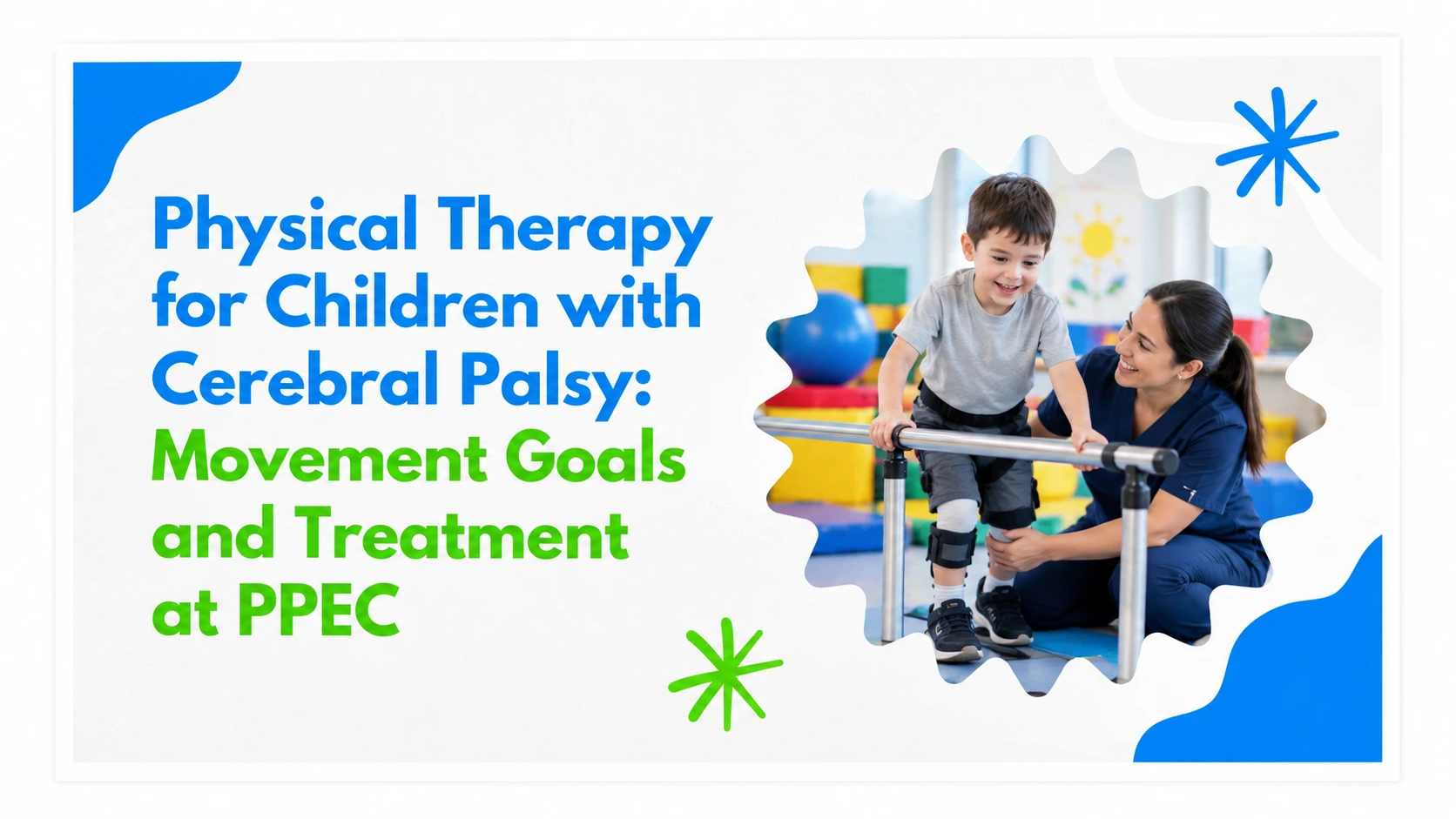
- Gait training, for children working toward walking or improving how they walk, often using treadmills, parallel bars, or supportive gait trainers
- Transfers and functional mobility, such as moving safely between a wheelchair, bed, or chair
The specific mix of these goals looks different for every child. A younger child might spend most sessions on foundational skills like supported sitting and reaching. In comparison, an older child, closer to independent or assisted walking, might focus more on gait speed, stair navigation, or community mobility skills.
Evidence-Based Approaches Our Therapists Use
Research on cerebral palsy treatment has shifted meaningfully over the past decade, and current international clinical guidelines are clear on what tends to work best: therapy built around real, functional goals that matter to the child and family, practiced in ways that resemble actual daily tasks rather than isolated exercises. At PPEC, our physical therapists apply this approach directly.
For children working on walking, this often means practicing overground walking rather than relying solely on equipment-based exercises, with treadmill training sometimes supplemented. For children building strength, this means resistance and strengthening exercises targeted at the muscle groups that support daily function, not generic full-body routines. Goal-directed training, where a child practices a specific, meaningful task repeatedly, such as reaching for a toy or standing up from a chair, has consistently shown better outcomes than passive stretching alone. These approaches are a core part of how PPEC therapists structure sessions.
Why Consistency and Frequency Make a Real Difference
Physical therapy for children with cerebral palsy tends to work best with intensive, consistent practice rather than occasional sessions spread far apart. This is one of the clearest advantages of the PPEC model. Because children attend regularly, physical therapy becomes part of an ongoing rhythm rather than a once-a-week appointment squeezed between other commitments.
A child working on standing balance practices that skill not only during a scheduled therapy session but also with their nursing and care team throughout the day during transfers, play, and daily routines. This kind of repeated, real-world practice reinforces what happens in formal therapy sessions far more effectively than therapy alone.
Positioning and Preventing Secondary Complications
A significant part of physical therapy for cerebral palsy is working to prevent problems before they can begin.Children with spasticity are at risk of developing contractures, or permanent tightening of muscles or joints, if positioning and stretching aren’t managed consistently over time.
PPEC physical therapists work closely with the nursing team to ensure a child is positioned correctly throughout the day, whether that’s in a wheelchair, a stander, or during rest periods. t These stretching routines are followed even outside scheduled therapy time. This kind of ongoing attention to positioning is difficult to maintain in settings where therapy happens only in isolated appointments. Still, it becomes a natural part of the day within PPEC’s integrated model.
Equipment and Assistive Devices
Many children with cerebral palsy use some form of assistive equipment to support movement, and physical therapists play a central role in identifying, fitting, and training children to use these tools effectively. This might include walkers, gait trainers, ankle-foot orthodontics, standing frames, or wheelchairs, depending on the child’s classification and specific needs.
Equipment needs change as children grow and develop, so the need for this equipment may need to be adapted or replaced over time. PPEC therapists reassess regularly and coordinate with physicians and equipment providers to ensure a child’s devices continue to match their current abilities rather than what was appropriate months or years earlier.
Involving Families in the Process
Physical therapy for cerebral palsy works best when it doesn’t stop at the end of a session. PPEC physical therapists can work with parents to develop home programs and practical strategies that families can build into everyday routines, whether that’s specific stretches, positioning tips, or simple activities that reinforce a skill being targeted in therapy.
Because families know their child’s daily life better than anyone else, their input also shapes which goals actually matter. A goal that looks good on paper isn’t always a reflection of what a family genuinely wants their child to be able to do, whether that’s walking to the mailbox, sitting independently at the dinner table, or transferring more easily in and out of a seat.
Conclusion
Physical therapy for a child with cerebral palsy is not about reaching a fixed, universal milestone. It’s about helping each child move in the way that works best for their body and supports the life they and their family want for them. At PPEC of Palm Beach, our physical therapists bring evidence-based treatment, consistent daily practice, and genuine collaboration with families to every child’s movement goals. Reach out to learn more about how our physical therapy program can support your child.
FAQs
What does a physical therapist actually work on with a child who has cerebral palsy?
Physical therapists address gross motor skills, strength, balance, coordination, flexibility, gait, and functional mobility, such as transfers. The specific focus depends on the child’s age, movement classification, and individual goals.
What is the GMFCS, and why does it matter for therapy?
The Gross Motor Function Classification System describes a child’s movement ability across five levels, from walking without limitations to requiring full assistance and a wheelchair. Physical therapists use the GMFCS during their evaluations and assessments to help set realistic, meaningful goals and communicate clearly with families and physicians about a child’s current abilities.
Can physical therapy actually improve a child’s movement, or is it mainly about preventing decline?
Both of these are true! Evidence-based physical therapy can meaningfully improve strength, gait, and functional skills, particularly when it involves goal-directed, functional practice. It also plays a major role in preventing complications like contractures through consistent positioning and stretching.
How is physical therapy at PPEC different from a weekly outpatient appointment?
At PPEC, physical therapy goals are reinforced throughout the day, not just during scheduled sessions. Because children attend regularly, therapists coordinate with the nursing and care team so that positioning, stretching, and practice of specific skills continue outside formal therapy time.
How do therapists decide what equipment my child needs?
Physical therapists assess a child’s movement ability, classification, and daily needs, then recommend and fit equipment such as walkers, orthodontics, standing frames, or wheelchairs accordingly. These recommendations are reassessed regularly since equipment needs change as a child grows. Equipment can be adjusted, repaired, and delivered to PPEC of Palm Beach.